
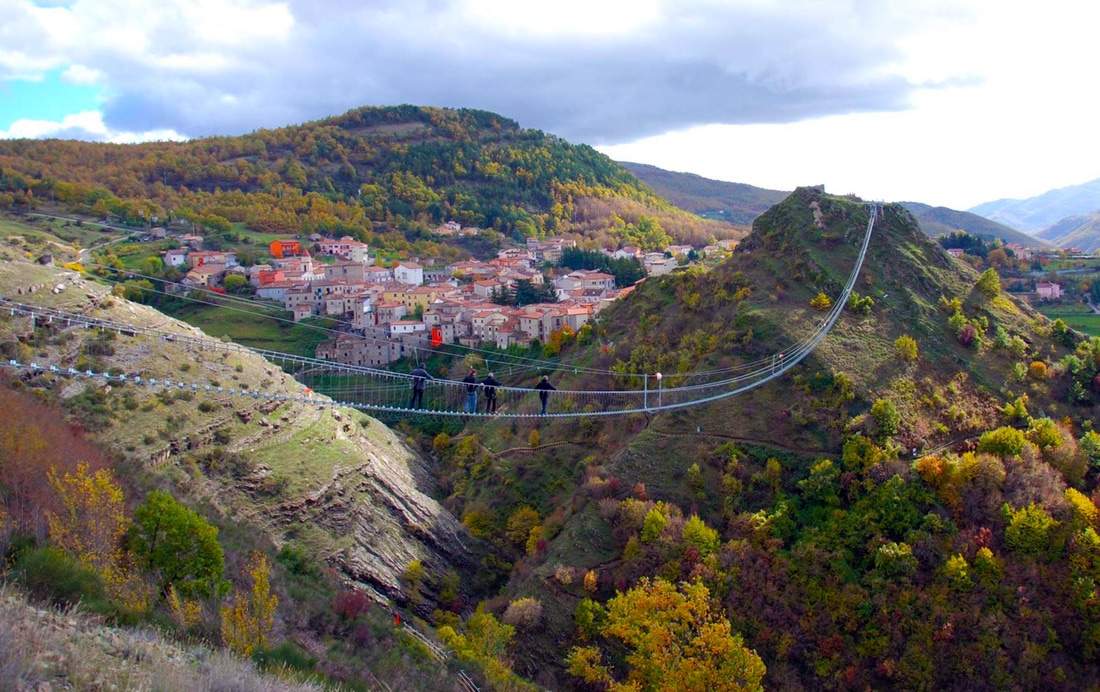
 I can attest to the fact that parts of Basilicata, a southern region of Italy, are very rugged, especially true of the area surrounding the villages of Castelmezzano and Pietrapertosa, tucked at the top of dolomite, jagged cliffs. These towns draw extreme sports enthusiasts with their Vol dell 'Angelo (Flight of the Angels), a high speed face down zip line hung between the two towns' clifftops.
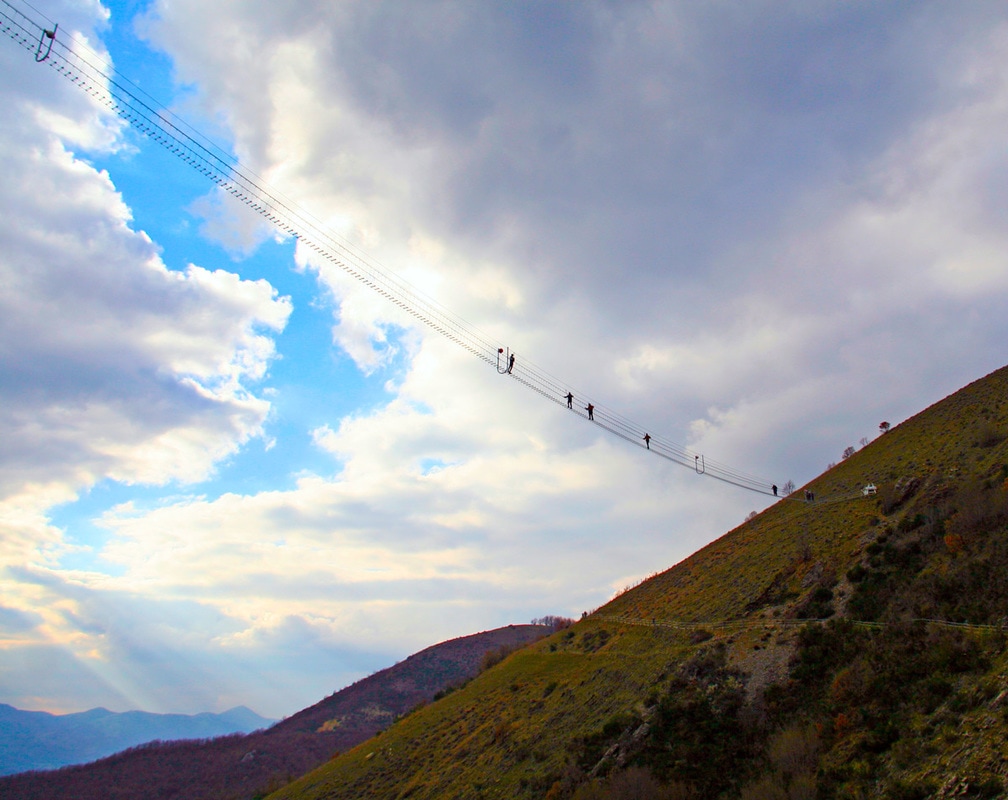
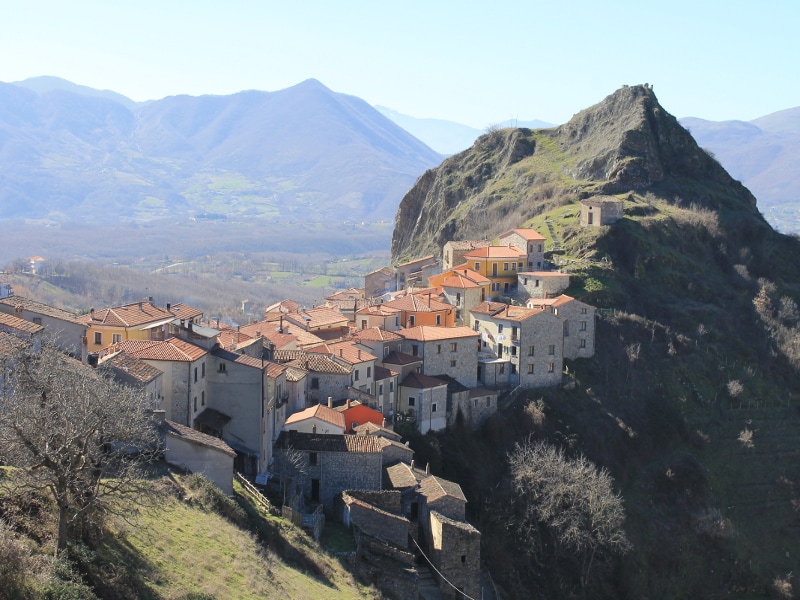 Sasso di Castalda There is lot in this region for the extreme sport or outdoor enthusiast: canyons, gorges and white water streams, biking through high mountain pastures while passing donkeys, sheep, cattle, ghost towns, and castle fortresses on hilltops... cross-country skiing in winter, and hiking and trekking trails, one of which brings you to a mountaineering-style cable bridge, hanging in between two mountains, 360 feet above the gorge and river below... Ponte della Luna (Bridge to the Moon) is accepting the first adventurers today--April 6th--who are brave enough to carefully walk across it's 900 foot span for a 30 minute, breathtaking experience. Safety equipment is required, but can be rented at the ticket office. There are 600 metal steps about 18 inches apart, which seem invisible when looking down, thanks to their open grid design. The views of the rustic village of Sasso di Castalda are amazing, but one shouldn't get too distracted! Open every day from 9am to 5pm € 15 adults € 10 children under 14 years Group discounts available Ponte della Luna Website   Isola Santa is a very old, Medieval village, built around a hospital for travelers and pilgrims on a cliff overlooking the river Turrite Secca. Before 1950, the borgo was sitting on top of an outcropping, but the construction of a dam for hydroelectric power and the resulting man made lake put the buildings at the level of the lake. The hydroelectric project forced the inhabitants to leave their homes. In recent years, a restoration project brought life again on the shores of the lake but Isola Santa has the feel of a Ghost Town, with most of the houses laying empty and only a few trout fishermen and trekkers passing through. The surrounding forest is full of chestnut trees and porcini mushrooms.  Church of San Jacopo Although tiny, the place is magical and very photogenic. The Church of San Jacopo, built in 1260 boasts a wonderful bell tower, and there is even a restaurant to indulge in a meal or two--Casa del Pescatore. Hikers and climbers can head off toward the peaks of the Apuan Alps from the village. And although it might look like snow in summer, those mountains are made of marble, as is nearby Carrara where Michelangelo saw his David in a huge chunk of the white stone.  The Beauty of the Apuan Alps and collines This is also Karst country--making this an area rich with caves. Worth a visit is the impressive Grotta del Vento (on Garfagnana), and the 1 mile long Antro del Corchia, which is the widest cave of whole Europe (on Versilia). This cave system contains over 30 miles of chambers and tunnels in its system. The Karst geology in the area also created streams that disappear into underground caves, only to reappear elsewhere as springs. Just before reaching Isola Santa is La Pollaccia, one of the more important natural springs in Italy.  Hikers will come across mountain huts like this one at nearby Col di Favilla If you are into hardcore mountain climbing, this is really the area for you. The mountains are rugged, they are world class with many peaks requiring a high level of climbing skills and equipment. If you're up to it, think about climbing Monte Forato just to the south of Isola Santa. It's got a prize at the top--a huge, natural land bridge forming a hole right through part of the ridge. --Jerry Finzi  Monte Forato
Piazza dei Miracola, Pisa Most people spend about a hour visiting the Piazza and taking their iconic "hold up the Tower" photos. If you would like to spend more time in Pisa, it is a beautiful town, looking similar to Florence as you stroll the banks of the River Arno. You can also buy timed tickets to climb to the top of the Tower. But a better plan would be visiting the Leaning Tower in the early morning or late afternoon (when cruise ship tours are not there) and plan a day visiting nearby Lucca. If driving, there is a pay-parking lot a block from Piazza dei Miracola.
St. Peters Square & Basilica, Rome If you want to visit the Basilica, it's free because it is a functioning Church, but you will have to wait on very long security check lines--often three hours! Bring water in hot months. It's a magnificent--if overly opulent--piece of architecture and the seat of Christianity, but if you are going to pray, you might not find peace here. It is very crowded, noisy and there are signs warning of pickpockets. If you want to visit for religious reasons, do so on Wednesday mornings when the Pope has his Papal Audience and addresses the faithful in the Piazza. There are free tickets for seats that you should obtain well before your trip and then you should arrive 1-3 hours before the Audience. Bring water, sunscreen and perhaps an umbrella--the Piazza can be very hot. Tickets do not guarantee a seat, but there is standing room for 80,000 people in the Piazza.
Sistine Chapel, Vatican Museum, Rome Don't expect to have a personal experience in the Sistine Chapel where you can sit and ponder the glorious creation of Michelangelo. Years ago, people would lie on the floor with binoculars and spend hours looking at the details. Those days are gone. Large tour groups are hustled in--and out--along with "private" tour groups (we had a private tour). They allow about ten minutes, and most of this is spent sweating, listening to the cackling crowd, with Oriental tourists donning hats, unaware that they should be removed when in a Catholic chapel of worship. And just try to get a seat on one of the side wall marble benches. If you want to savor the Sistine Chapel in both high resolution detail views and in 3-D, click HERE.
Spanish Steps, Rome The Steps are in a chic shopping district where you might not be able to afford their offerings. There is poet John Keats' home above, an English tearoom nearby, a beautiful Fountain of a Roman Galley below and lots of tourists taking the load off their weary feet. I don't see the attraction.   Colosseum, Rome It's easier to buy your tickets at the entrance up the hill slightly at the entrance to Palatine Hill. The 2-day tickets are good for the Hill, the Forum and the Colosseum. I suggest making your visit to the Colosseum in early morning (stand on line at 8am) or 1-2 hours before they close. Avoid the middle of the day, especially in summer--there is no shade.   Pantheon, Rome One of the best and most interesting times to visit would be in the middle of a rain storm... the rain falls to the marble floor from the 27 foot occulus above making a beautiful sound. High noon would be best to see the sun shine straight down. Beware of pickpockets inside this functioning church! The piazza outside is lively and worth a visit. To avoid crowds, early or late in the day is best.
Piazza San Marco, Venice Stay clear of Rialto and San Marco--that's where most tourists flock. Instead, check out San Giorgio Maggiore, the island just across from San Marco. Enjoy the views looking back at the Campanile. The colorful island of Burano is also worth a visit. Wander the back streets and alleys of Venice to avoid the crowds. Later in the afternoon when the cruise ship groups have gone is much more calm.
Trevi Fountain, Rome Very early in the morning, or late evening is best, otherwise you will have to wait your turn to get close to the edge of the Fontana to ensure your return to Rome by the traditional coin toss.
Cortona (of Under the Tuscan Sun fame) There are many other amazingly beautiful Tuscan hilltowns worth visiting other than this over-hyped, buss tour destination town. Try Pienza, for instance.
Vatican Museum, Rome Almost nothing helps avoid the crush of people and the large tour groups. If you book a Private Vatican Museum Tour, talk him into getting you to the Sistine Chapel ASAP, if you want to savor it without throngs of disrespectful tourist groups, otherwise, the rushed tours will eventually swallow you and your "private tour guide" up.
Juliette's Balcony, Verona Skip it entirely. Consider that Romeo and Juliette are fictitious characters. No one named Juliette ever lived here, and there is no evidence that Shakespeare ever stepped foot in Italy. Bus tours dump throngs of people off here to pay an entrance fee to a house that has nothing to do with Juliette, and they grab and polish Juliette's bronze boob on the statute below. Teens write love notes and post them on the wall with chewing gum. Get tickets for an opera in Verona's Roman arena instead.
Uffizi Gallery, Florence Very early in the morning (8am) or late in the afternoon (5pm) will be less crowded.
Michelangelo's David - Accademia, Florence Accademia tickets are to be reserved (by scheduled time) way ahead of your visit. Later in the day is best to avoid crowds.
Shopping in Florence Save your shopping for the Oltrano district, on the other side of the Arno River and avoid the tourist counterfeits and shoulder-to-shoulder crowds. You will find authentic craftsmen for leather, jewelry, ceramics, clothing and more in the Oltrano.
Gondola ride in Venice Try to get a gondola ride later in the afternoon when the tour buses have left to avoid a traffic jam on the canal.
Ischia beach, Naples This is where locals go--way too many of them. The beaches on the mainland due north of Ischia are much less crowded.
Driving the Amalfi Coast Road The roads are extremely narrow with enormous traffic in the high season. Large buses, motorcyclists, bicycles and tandem 18-wheelers make it terrifying to some. The town of Amalfi is a tacky tourist trap. Go to Atrani, Cetera, Minori or Maiori instead. Head to Vietri sul Mare for the best ceramics. If you do drive, rent a small car!
Pompeii Archeological Site Buses dump off large tour groups from cruise ships. Late afternoon visits are best. Bring a refillable water bottle and use the many fountains around the site. There is an Auto-Grill on site for lunch. Wear comfortable shoes--walking on uneven, 2000 year old paving is rough going in Pompeii.
La Bocca della Verita Grand Voyage Italy's mascot, the Bocca della Verita (Mouth of Truth) is well worth the visit. It's very close to the Roman Forum and across from the Temple di Vesti. It's worth the ten to fifteen minute wait on line to test your truthfulness by placing your hand in the Bocca's mouth. If you leave with your hand intact, you're a truthful person. The chapel inside is worth a visit, too. --Jerry Finzi Copyright 2017, Jerry Finzi/Grand Voyage Italy - All Rights Reserved
  In the area north of Trieste on the Carso (Karst) Plateau in the northeast Italian region of Friuli-Venezia Giulia, the land is made up of limestone caverns, rugged cliffs and soils... a perfect place to grow fine wines. The region is an ethnic blend of Italian, Slovenian and Austrian influences. In fact, some of this region used to be part of either Austria or Yugoslavia. The advantage to the Voyage here is having a blend of wines, cheeses, salumi and other gastronomic treats.
 A great way to get a taste of the specialties produced in the area is to search out the many local Osmize (osmizza, ossmizeri), a sort of home-based tavern where you can sample the formaggio, prosciutto, meats, sausages, eggs, grappa, pickles, olive oil and other things produced by small scale farmers. And of course, there are the local wines: mostly Teran, Vitovska, Malvasia, both reds and whites served in carafes and in no-nonsense glasses without stems. The people serving you are the same people who grew, nurtured, bottled, aged and otherwise perfected the delights they offer. They will slice the prosciutto off the huge hams and make your omelette to order for you. These are small family farms, pretty much hidden in suburban areas, often having a series of picnic tables in their backyard, tables tucked under the olive trees or even rustic taverne built into their cellars or patios, complete with wooden wine barrels, overhanging arbors, fire grills and even musicians to entertain you with accordion, guitar or hand drum. Everyone joins in the singing, even if they don't know the words... 
History of Osmize The name itself is of interest: Osmize (also Osmizza, Osmica) is a word based on the Slovenian osem, which means "eight". A short history of the custom of Osmize will explain... Historians can trace the existence of osmize back to medieval times in a document from 1430 shows that wine sold in bulk by peasant producers near Trieste would not be taxed. This was reinforced in 1784 by Joseph II of Hapsburg who decreed that farmers could sell bulk wine from their homes for periods of eight days each year. The custom stuck, only nowadays, the farmers themselves decide when they are open or not. They are also opened all year round, with the warmer months being favored due to the beautiful weather to enjoy the al fresco experience.    How to Find an Osmiza? This is where the fun starts. You see, Osmize don't advertise. They don't have prime locations on the main roads. They are located in the countryside and amid the suburban sprawl outside of Trieste and around the towns of Longera, Piscianzi and also across the border in Slovenia. As you drive trough the area by car or bicycle (a very popular way of seeing the area) you will start to see a small wooden arrows with a cutting of ivy branches tacked to poles, walls or fences. It's sort of like when you follow a series of signs in the U.S., like way-points, to find a remotely located barn sale. There will be several signs leading you to the osmiza. When you arrive, don't be surprised at how unassuming it might appear. You might at first think you're in the wrong place, and trespassing into someone's home. But that's the point. These are peoples' homes. 
The wines grown in the Karst will include the sour, black-red Terrano with an intense flavor; Vitovska, a light, fragrant white wine with hints of almond; and the aromatic Glera the its deep yellow color and aromatic flavor. You will be able to buy cases of wine, bottles or simply enjoy a carafe and enjoy the wines in a more casual way.  So if you are looking for a more casual way to go wine tasting, consider a drive north of Venice into the Friuli-Venezia Giulia region and set out to "Visit the branches", as the locals say. Slow down... drink, eat, relax and discover that wine tasting doesn't have to be in a tall, thin stemmed crystal glass, slurping isn't necessary and you can enjoy the vino with the people who grew the grapes, aged the wine and bottled it. There are no pesticides on the food served. You can sit among strangers and feel like lifelong friends within the hour. The seasons change, the views can also change, but the feeling is all famiglia. --Jerry Finzi
 Pitigliano and the early morning mists  Click map for high resolution view Once of the most interesting, historic, centrally located, and rustic Off the Tourist Path places to visit in Italy is the cliff-top,village of Pitigliano in the Grossetto district at the southernmost border of Tuscany. Located about a 2-1/2 hour drive from either Florence or Rome, this is a perfect place to use as a base for a longer (2-3 week stay) in Italy. There are an amazing number of unique things to do and see in the immediate area, and day trips to Rome, Florence, Pisa, Siena or other Tuscan towns are very doable. The town was literally carved from the volcanic tufa rock it sits upon, with the entire town sitting above a series of tunnels and caves containing wine cellars, underground chapels, shrines, tombs and barns. Many of the homes are hybrid in this respect, some rooms are essentially caves carved from the mountain, while other rooms were built of stone on top of the cliff.
 History Pitigliano and its area can be considered the heart of Italy, where the Etruscans lived around 800 BC, long before the Ancient Romans. It is said that many of its structures today date from the Middle Ages, circa 1000 BC. In the 13th century, its medieval life was supported by the noble Aldobrandeschi family and was the capital of the surrounding countryside. In 1293 its rule passed to the Orsini family, which began a 150 year war with the feudal state of Siena. In 1455, Pitigliano was placed under the sovereignty and protection of Siena. Later on, it fell under the rule of the Grand Duchy of Tuscany (1562), and finally united with the Kingdom of Italy.
Some of the underground caves of Pitigliano  The synagogue is dated 1598 Piccola Gerusalemme Pitigliano, has been a home to Jews as early as the end of the fifteenth century. This tiny state allowed the refuge of several Jewish families, who worked primarily as money lenders. There were enough Jews to afford the construction of a Temple in 1598. In the seventeenth century, however, the Medici and the Grand Duchy of Tuscany ordered that the Jews be confined to a ghetto. Soon after, realizing the Jews contribution to their economy, the Jews were given more privileges, including the right to own property. There was a steady migration of Jews from surrounding communities and the Jewish population grew. By the eighteenth century, Pitigliano had the only remaining Jewish community in Maremma in south-eastern Tuscany. After this, the coexistence of of Christians and Jews was so entwined in the town, that it was given the nickname of Little Jerusalem. Via Cava - The Cave Roads of Tuscany
 Etruscan Ruins Since the time of the Etruscans, the Via Cava were carved from the volcanic tufa rock to connect villages in the area of Pitigliano for trade. Many are original from Etruscan times, while others have been continually carved and deepened either by man or erosion. These are amazing roads to travel, often appearing as chasms 50 feet deep, and others winding through leaning cliffs causing the trekker to ponder what lies around the next turn. Today, Voyagers can visit and hike the caves by foot, ride through on mountain bikes or go on horseback. You will find a mix of Etruscan history, early pagan and Christian tombs and chapels, and more. Well worth a visit: the Citta del Tufo Archaeological Park.  Cave tombs at the Citta della Tufo Sovana and Sorano and More  The main piazza of Sovana In the surrounding area, there is a lot to see. The nearby villages of Sovana and Sorano are connected by the Via Cava and although they are both tiny villages, have a lot to offer.
 Sorano at night Little is know about the beginnings of Sorano but its roots more than likely are with the iron age Villanovans, with Etruscans coming soon after. During Roman times, there is little known of the village, but in 862 AD came under the protection of the Aldobrandeschi family. The main sights are the Rocca degli Orsini (Castle Orsini) and the Masso Leopoldino, a terrace atop the natural outcrop of the mountain that was carved to appear like a massive fortress from a distance by Gran Duke Leopold. It has all the defensive looks of a fortress without all the expense of soldiers and weaponry. Genius. Below the town are beautiful stretches of the Via Cava and many archaeological sites.
If you stay in Pitigliano for an extended period, there are many side trips and day trips you can take. A little more than a half-hour's drive away is Saturnia, a natural hot spring--with both formal chic spas and natural springs that locals use for free. Another half-hour to the east is the lake town of Capodimonte, the largest town on the banks of Lake Bolsena, an 8 mile wide lake in an ancient volcano's caldera. And winin an hour and a half drive you can visit the wine towns of Montalcino, Montepulcino, and Pienza of Pecorino cheese fame (and our choice for a "perfect" Tuscan village). If you're a romantic and want to experience the Under the Tuscan Sun (video on Amazon) lifestyle in Cortona (even though it's VERY touristy due to the film), it's about a 2 hour drive from Pitigliano. And you're about 1 hour from the 6000 foot tall Monte Amiata, where you can ski in winter and enjoy hiking and mountain biking in summer. --GVI
 Capodimonte peninsula surrounded by Lake Bolsena Here's a sampling of the unique rental apartments available in Pitigliano, from $50 to just over $100 per night... on AirBNB:
  A mine visit can be an interesting part of your visit The Trompia Valley is one of three main valleys in the province of Brescia in the Lombardy region with the Mella River winding through the territory for more than 20 miles. The presence of a large amount of raw materials, such as iron, made mining such a large part of this region's industry and success ever since Roman times... in fact, the Valtrompia was a center for weapons production throughout history. 
There are also many sagre, fairs and festivals which take place throughout the year showcasing the most typical dishes of the local cuisine. Falling in between two of the most beautiful Italian lakes--Lake Iseo and Lake Garda--makes the region a fantastic destination for an extended stay in any season of the year.  Biking on one of the high mountain trails  Ossobuco seems to go along with the rugged nature of Valtrompia The region of Lombardy is also a place to experience one of the varied cuisines that make up Italy's culinary palette. Rather than relying on olive oil and tomatoes, the dishes here embrace corn and corn meal, rice beef, pork and butter. In some cases you will see relationships with the cuisine of Austria, France and Germany. One of the more famous dishes is Risotto alla Milanese, the saffron colored treasure. The other regional specialty is polenta, made with corn meal. For meat lovers there's Cotoletta (breaded veal cutlet), Cassoeula (pork or chicken casserole) and Ossobuco (braised veal shanks). For dessert you can enjoy panettone. If you love cheeses, the region is the home of Grana Padano (a cousin of Parmigiano Reggiano), Talegio and Gorgonzola.  A devil or an ingredient source for cheese making--you decide. The Valtrompia is a land rich in traditions, hunting, myths, legends and folk tales. There are tales of as many as 60 witches being burned in the fifteenth century, devils masquerading as mountain goats, healers and sorcerers. There are also stories of romance and jealousies that led to murders, with the troubled ghosts haunting castles high up in the mountains. Perhaps a visit to this area will haunt your memories--forever. All in all, Valtrompia is well worth a visit for Voyagers wishing to discover the beauty and culture of the Italian Alps. --Jerry Finzi Copyright 2017, Jerry Finzi/Grand Voyage Italy - All Rights Reserved
 Evening in Vernazza 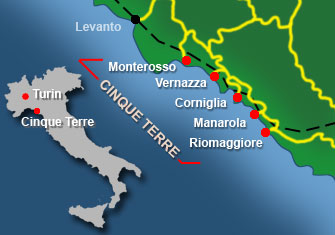 Amalfi Coast versus Cinque Terre Especially in the peak tourist months, the Amalfi Coast is bumper to bumper tour buses and its towns are chock full of tourists stepping on one another's toes. I wouldn't dream of driving the Amalfi Coast in summer--it was crazy enough in October when we were there! And I wouldn't want to rely on the sporadic local bus schedules--waiting for an hour just to get on, and then standing for an hour or more just to get to a destination. The cause? A blood-curdling drive going around hair-pin, cliff-hanging curves at the blazing traffic jam speeds of a mere 6 miles an hour. As for beaches... well, there really aren't many true beaches to speak of on the Amalfi Coast. Some of the towns can be overwhelmingly crowded in summer. As example, Amalfi-town is a kitschy, touristy hell that you're forced to drive through, but I don't recommend stopping. Towns like Atrani, Minori or Maiori are much more laid back. But, If you still looking for cute colored houses, clinging to rugged cliffs over the sea, then I have a suggestion: Instead of going to Amalfi, go where the tour buses aren't dumping off thousands of tourists--Cinque Terre in the northern Italian region of Liguria!  Manarola  Taking a smaller water taxi affords a more personal experience rather than the larger, over-crowded (high season) large ferries Cinque Terre literally translated means Five Lands, a reference to it's five towns: Monterosso al Mare, Vernazza, Corniglia, Manarola, and Riomaggiore, and even it isn't technically part of the Five Lands, I would include the wonderful port town of Portovenere just to the east, itself including the villages of Fezzano, Le Grazie and Porto Venere, and the three islands of Palmaria, Tino and the tiny Tinetto. If planning to visit the area, strongly consider getting out on the water to really experience this rocky seascape close-up. Take ferries from town to town, hire a captain or (if you are an experienced boater) a bare-boat rental and you will never regret it. The Terre's rugged coastline rivals the Amalfi Coast in beauty and its five villages along with the surrounding cliffs are part of the Cinque Terre National Park and is a UNESCO World Heritage Site. The advantage of visiting Cinque Terre is that cars (as well as tour buses) can't reach the villages. They are only accessible by local trains, by foot paths (old donkey paths) running between them or by boat-taxis and ferrys. While the Amalfi Coast is invaded by tour buses from cruise ships and has more tourists because of its proximity to Naples, Sorrento, Capri and Pompeii, the Cinque Terre villages stand on their own. If you are staying in Cinque Terre, there are very doable day trips to Genova, Portofino, Pisa, Lucca (our favorite) and even Florence if you have the extra time to take a train or rent a car.
 A view from high above Tourism in the villages is more laid back than Amalfi. Here you will find more low modest hotels and rental apartments and more B&Bs than in Amalfi where chic Luxury hotels abound. And although Amalfi has some great hiking with its Sentiero degli Dei (Path of the Gods) high above its Coast Road, Cinque Terre also has paths connecting each village with wonderful views. Keep in mind however, that these walking paths--although well paved and often becoming wide promenades--have lots of people walking them in the high season and some parts can be very rugged in terms of changes in altitude --lots of ups and downs--so you'd better be in good shape. I wouldn't recommend Cinque Terre for seniors or anyone with heart or breathing difficulties. In Amalfi, the Path of the Gods is for more serious hikers with some easier parts paths mixed in all throughout the peninsula, but most of the tourists are going to the chic towns of Positano and Amalfi-Town--the place is very touristy. In Cinque Terre, there is Sentiero Azzurro running between the towns, as well as other more challenging hiking trails in the surrounding naturalized park areas for hard-core trekkers. Want to experience even more of the less-touristy areas of Cinque Terre? Then start at the top, overlooking the the Five Lands. There are many small villages, like Groppo and Valostra, which are all interconnected by hiking paths. To start, you can actually drive to Valostra, park your car in the free lot, and hike from village to village to your heart's content. The villages above Five Lands are definitely less touristy. The views of the sea from over 1000 feet elevation are something you'll remember your whole life. When you get a bit tired, you can always hop on a shuttle bus--they are all over this area.
 Sunning on the rocks of Tinetto island When visiting Italy in early spring or fall, you might have better weather in the south, but by American standards, the weather is still warm enough to enjoy a slightly off-season trip to Cinque Terre. In late October the rains and some winds start to come, so plan your trip earlier in the month. If you want to swim in the sea, plan your trip at the shoulder of the high season. If you don't mind more crowds, humidity and heat, plan your trip in summer. Personally, I would also squeeze in some time in Portovenere and perhaps have a water taxi drop me off on the Isola Palmeria--a national park with wonderful naturalized beaches that look back at the the town. There are hiking tails on the Island with amazing views and lots of nature to enjoy.  Portovenere  Every town has a train station Of course, you might not want to hike between all of the towns... The trains are very convenient. Cinque Terre trains connect six stops: La Spezia (the large town to the east of Cinque Terre, where you make connections to other major Italian cities) the official "Five Lands" of Riomaggiore, Manarola, Corniglia, Vernazza, and Monterosso, and the town of Levanto. If you're coming from elsewhere in Italy, you would have to connect to either Florence, Milan, or Venice and then move on to La Spezia to connect with the Cinque Terre train system. From La Spezia to Riomaggiore is about 10 minutes, and then roughly 5 minutes between each town thereafter. And although some would say the trains run on an irregular, unreliable schedule, you can still catch a train every hour or so. This is Italy, after all. You can also travel between towns by water taxi which leave every hour or so.
The simplest walks between towns are between 3/4 of a mile and 2 miles so you might plan on walking through all Five Lands... The Monterosso to Vernazza path is the most demanding and can easily take about two hours, while the By comparison, the Via dell'Amore which clings to the cliff above the sea, is all paved and relatively flat and can be walked in as little as 30 minutes. The Via dell’Amore has become a world-famous landmark in its own right with lovers placing locks enscribed with their names professing their unbreakable bonds of love. The keys are tossed into the sea. This is an easy walk when compared to the vigorous hikes on the rest of of the Sentiero Azzurro. Bottom line? Cinque Terre can be much less touristy than the Amalfi Coast if you don't visit in the high season, has less of that chic element and more of the backpacker feel, and is more suited to serious hikers, walkers and lovers looking for a more intimate getaway. --Jerry Finzi  Click to see the high resolution map Copyright 2017 - All rights reserved - Jerry Finzi/Grand Voyage Italy
 The weather on the Adriatic Sea on the eastern coast of Italy can get very rough--at times too rough for fishermen to voyage out to sea to fill their nets. About 2000 years ago, the Phoenicians invented a sort of land-based fishing machine that could catch fish even in rough seas. Although many believe this is the reason for their invention, some claim that farmers invented the structures to supplement their food supply during times of poor harvests. Whoever invented it, the trabucco (not to be confused with the same Italian word for a trebuchet, a military weapon) has become a proud part of the maritime history of Italy...  Dining at a Trabucco is one of the most unique dining experiences in the world 
 A trabucco (also, trabocco or travocc) looks like the upper parts of a sailing ship built on the craggy edge of a small prominence jutting out into the sea. To the a fan of Steinbeck stories, they might appear to have jumped right off the page from one of his stories about the fishing villages on the northern California Coast. Essentially, a trabucco is a fishing shack with attached decks built on stilts. Nets are rigged onto long pine poles called antennae jutting out over the water and then dropped into the paths of passing schools of fish. Since schools of fish often navigate closely past such points of land, the trabucco became a very efficient method of fishing. In the early part of the 20th century, a successful trabucco could catch enough fish for up to 10 families. 
 Trabucci are found along the coasts of Abruzzo (especially along the Costa dei Trabocchi, a coastal area named for them) and the rocky Gargano peninsula in Puglia where they are protected as National Monuments. Although some are still used today for fishing, they have become treasured monuments to the history of fishing in southern Italy, many being restored into seaside restaurants and bars. They can also be found along the coastlines of the southern Adriatic, especially in the provinces of Chieti, Campobasso, and Foggia and also in some parts of the coast of southern Tyrrhenian Sea on the west side of the Boot. If you are ever in Abruzzo or in Puglia on the Gargano peninsula (a fantastic beach destination), plan on having lunch or a romantic dinner at one of these trabucci turned into eateries. It will be a high-point of your voyage and one of the most unique dining experiences of your entire life... Here is a tripadvisor listing of trabucci restaurants. Enjoy! Ciao! --Jerry Finzi  |

Categories
All
Archives
November 2025
|



 RSS Feed