
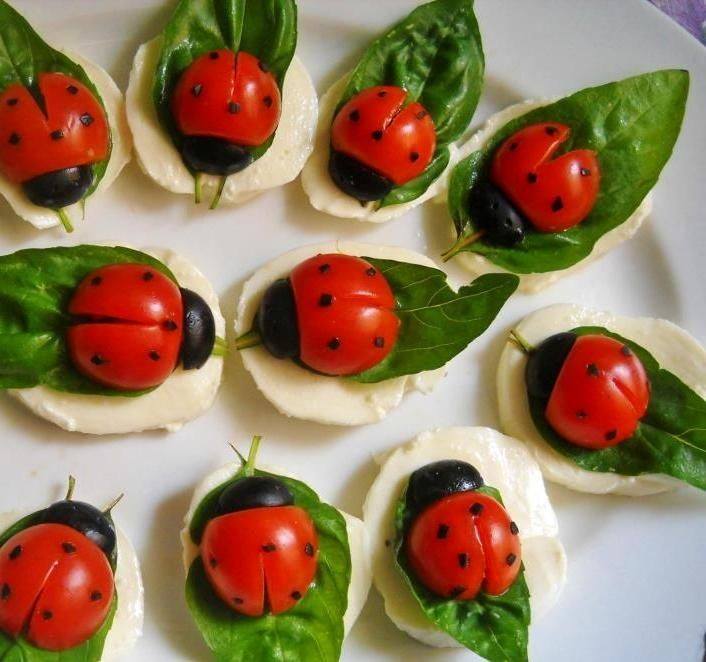
 Lady Bug Caprese Salad. cherry tomatoes, black olives, basil leaves, and mozzarella And the dots.... drum roll.... (go to the bottom for the surprise. but see if you can guess first).... The dots are spots of thick balsamic vinegar! --Jerry Finzi If you enjoyed this post, try these others....
7 Comments
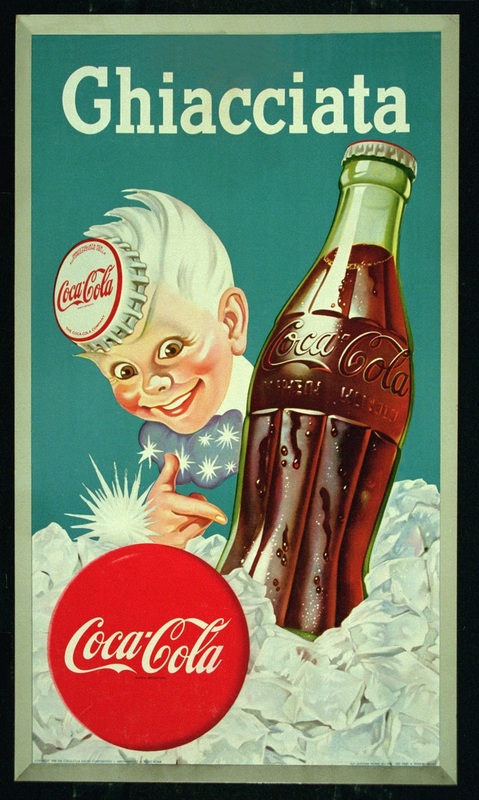
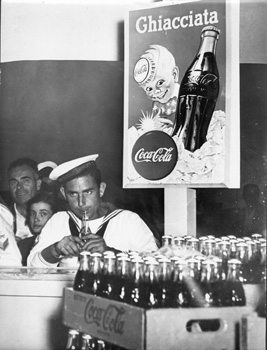
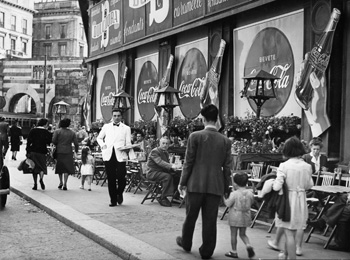
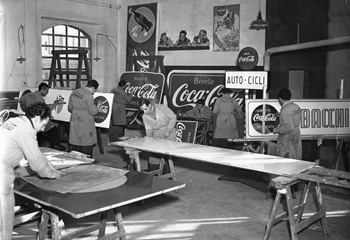
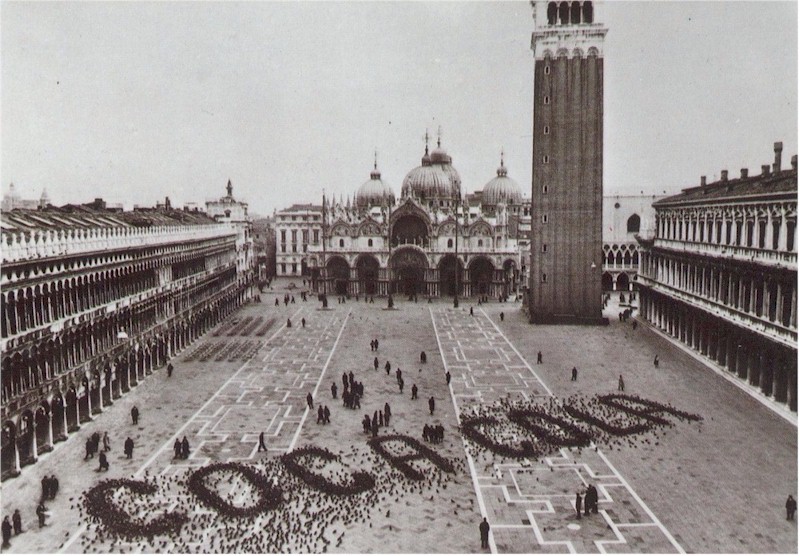 Classic Italian Coca Cola... pigeons and birdseed in Venice 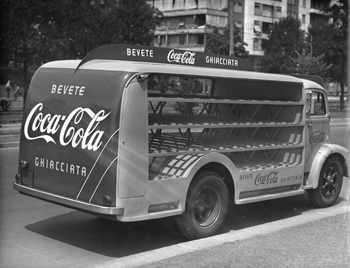 In 1894, Coca Cola opened it's very first bottling plant. The first Cokes were sold to the public in 1886 at the soda fountain of Jacob’s Pharmacy in Atlanta, Georgia in the United States. In Italy, in 1927, Romana Acque Gassose opened the first Coca-Cola manufacturing and bottling plant in Italy. This was followed in the 1930s by the bottling companies SRIBEG in Genoa and STIB in Leghorn, and by FAMIB in Milan, which manufactured and marketed soft drinks under The Coca-Cola Company trademark. The independent bottling companies subsequently multiplied to the point where they were in a position to distribute Coca- Cola products all over Italy. In 1995, The Coca-Cola Company, global leader in soft drinks boasting 4 of the world’s 5 biggest brands (Coca-Cola, Coca-Cola light, Diet Coke, Fanta and Sprite), decided to handle its Italian operations directly and accordingly bought the 11 bottling companies located in the north and center of the country... by 1998 there were 16 such plants.
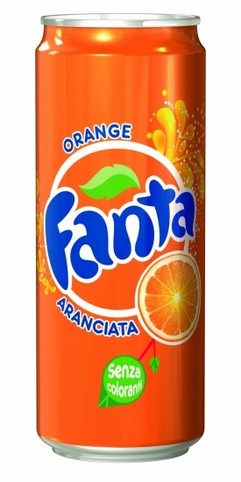 When we visited Italy, Coke was everywhere. For me, I drank Fanta Aranciata... in Italy, a totally different drink than Fanta here in the States. In the U.S. it's a bright, artificial orange color with an overly sweet, chemical taste. In Italy, it's actually made with orange juice. It's fresher and more natural tasting--imagine orange juice and seltzer. I loved it. But for my boy, Lucas and wife, Lisa, once in a while they needed a Coke fix. Lucas loved Coke Zero... he said it tasted the same as here, but Lisa said it was less sweet. In general, sodas in Italy are very different... and they usually are less sweet. Italians like more fruity, sour flavors--bitter too. But make no mistake about it... you'll find Cokes everywhere in Italy.
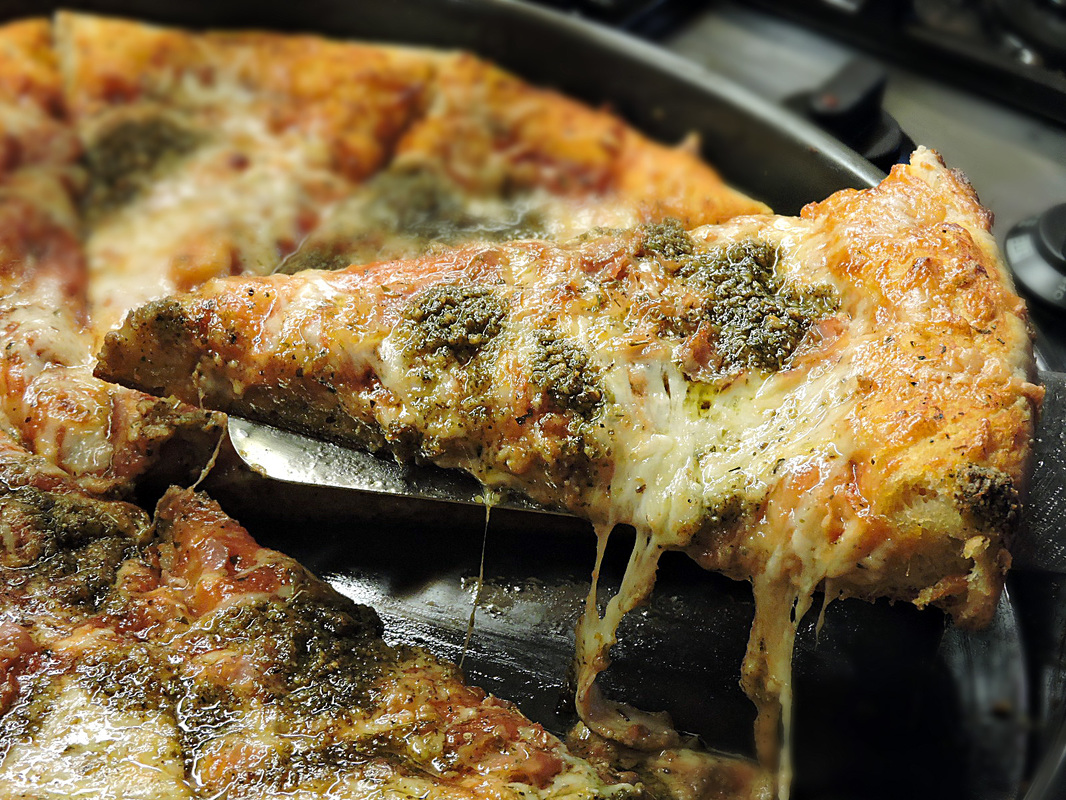 Here's a photo of our pizza last night: A large wheat pan pizza with mozzarella, sharp provolone, prosciutto and dollops of pesto here and there.
Use my Basic Thin Crust Recipe, but replace 1 cup of the bread flour with 1 cup of White Whole Wheat flour. You can use any pizza sauce of you liking, but if you would like to make your own from scratch, try my Pizza Sauce Recipe. Buon appetito! --Jerry Finzi 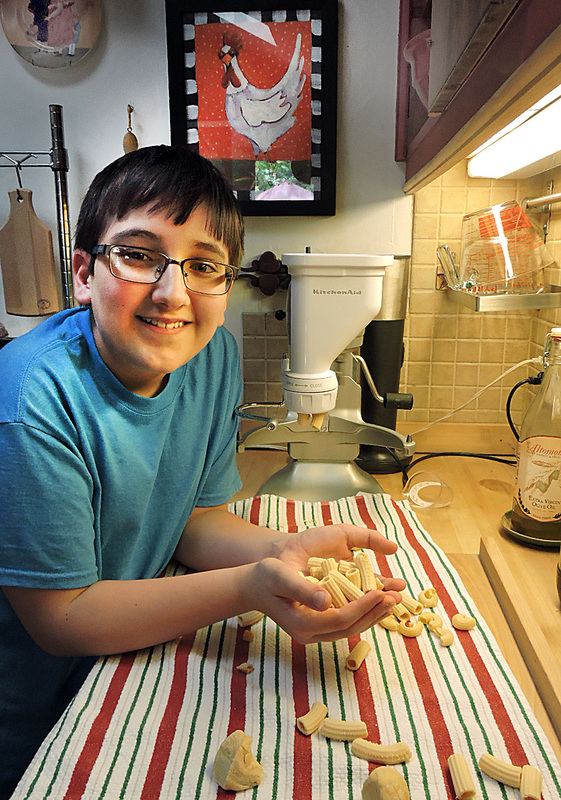 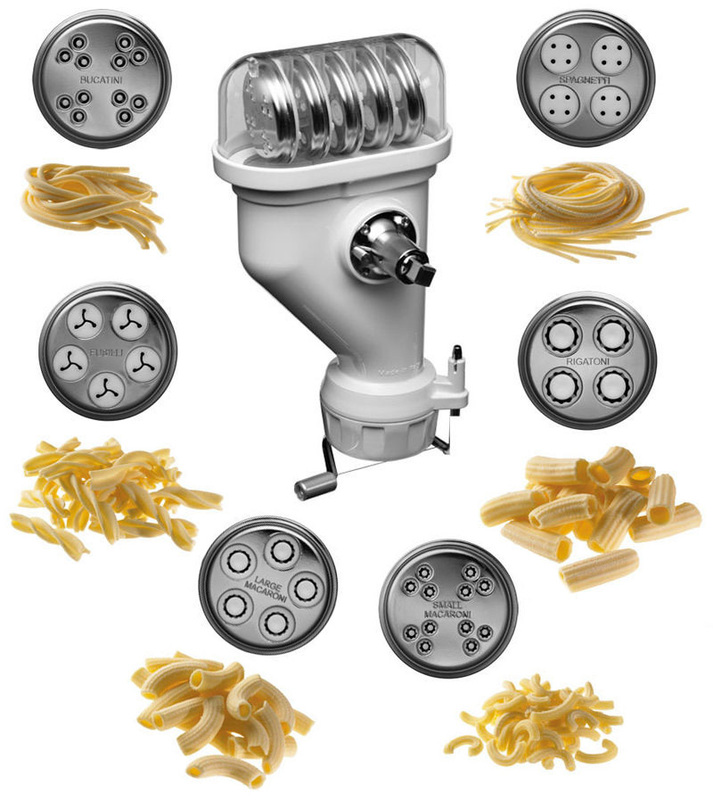 We've made fresh pasta before. My son, Lucas and I are usually the pasta-making team. We've made it totally by hand with the flour-well method and rolling pin and we also make it with out pasta roller attachment for our KitchenAid stand mixer. For lucas and I, it's a bonding experience... we make it together and get great satisfaction knowing that WE did it, ourselves. There's nothing like eating tender, fresh pasta that you've just made. When it came time to decide on my wife, Lisa's birthday present this spring, we thought we'd get her into the fresh pasta-making action, too. The KitchenAid Pasta Extruder attachment was a natural for our kitchen and for creating a new Extruded Pasta Team--Lucas and Lisa. Like all KitchenAid products, this unit seems like it's built by NASA engineers. I'm always pleasantly surprised at the engineering that goes into their equipment. No cheap plastic parts here... this thing will last for decades. And even though the die shape inserts themselves (surrounded my metal plates) are made of a plastic, they seem to be made of an industrial strength nylon. For $134, I wouldn't expect commercial grade bronze dies, anyway. The thing that really impressed me was the pressure that this thing has to endure when extrusion is actually happening... Being the first time out, Lisa set out to use the "Basic Egg Noodle Pasta" recipe in the KitchenAid manual: Ingredients 4 large eggs 3-1/2 cups sifted all purpose flour 1 tablespoon water 1 teaspoon salt Directions
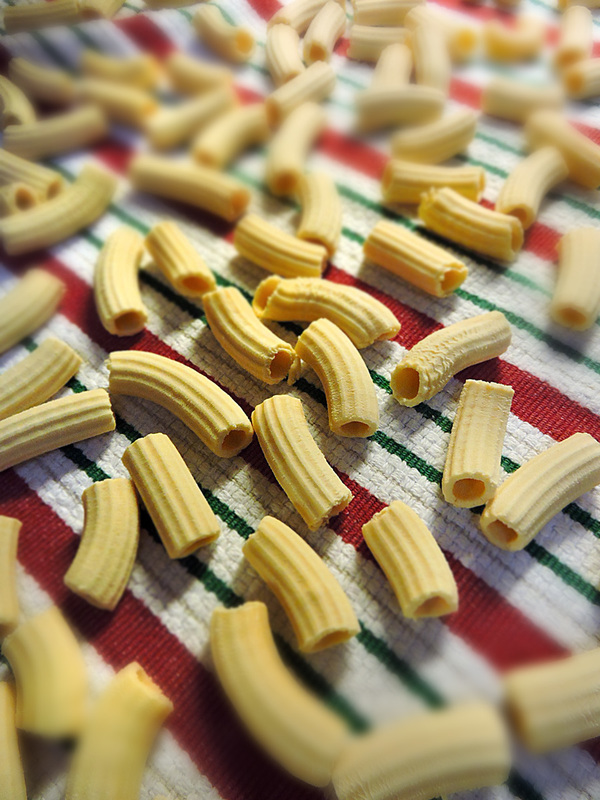 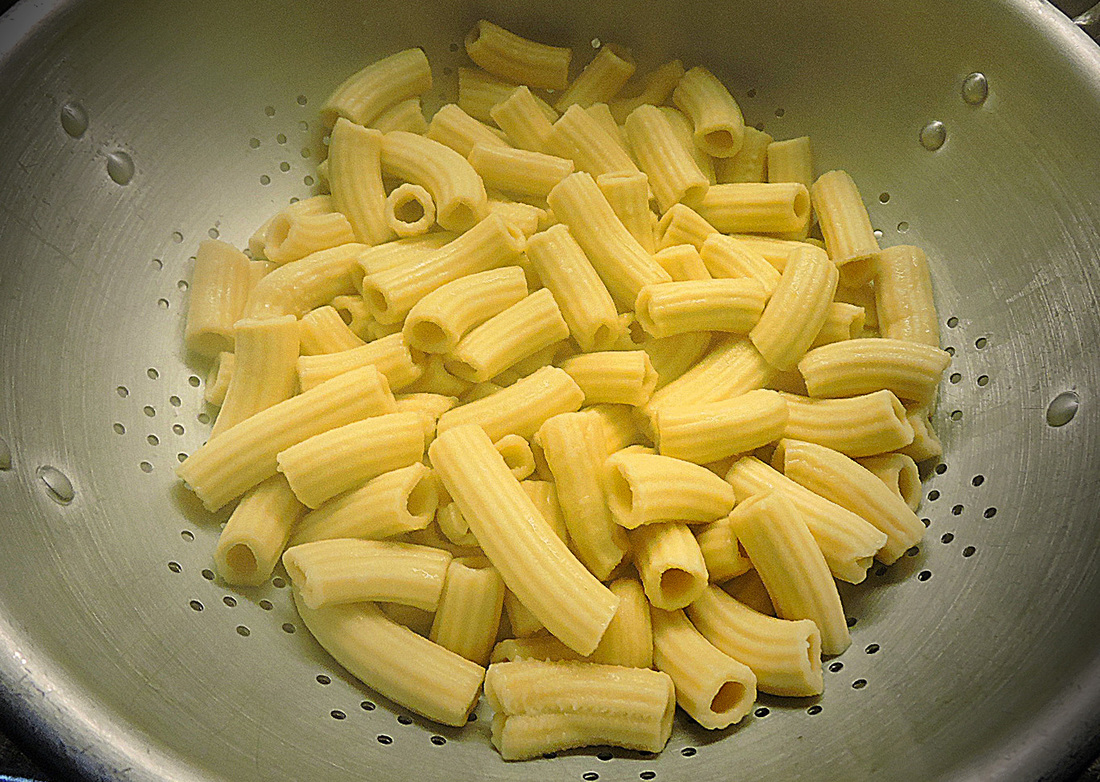 Ok... here's my own observations on this whole process; I stepped back and let this be a Lucas and Mom project, but then Lisa called me in when she noticed the dough was very tough and nearly impossible to knead into a "smooth, pliable" dough ball. Now as I said, Lucas and I have made fresh pasta before... but extruding is a bit different. In general, the dough has to be a stiffer mix to hold up to extrusion. If it's too soft it will make a sticky mess when put through the extruder. My first reaction to the dough when I saw it was to toss it and start from scratch with a new recipe. It was really tough. I rolled it up in plastic wrap and put it aside and went online to find a typical recipe for extruding pasta. By the time I came back, Lisa said she took another look and her dough was a bit softer. In fact, it had relaxed a bit, so I kneaded it a bit--a real muscle job--and Lisa started to cut the walnut sized balls. Putting the shape disk on was easy. The machine fired up and Lisa dropped a a bunch of balls into the hopper to top it off. Slowly, pasta began to extrude... very slowly at first. Our mixer didn't bog down, even with the heavy dough. Then it stopped. Apparently, you need to feed one or two balls of dough at a time and the auger at the bottom of the extruder presses the dough against the shape disc. Lisa put too much into the auger and there was a gap. We pulled out the dough, then started adding balls no more than two at a time. Past was being made... a pretty acceptable rigatoni shape! Then Lucas took over the cutting... waiting until the rigatoni was about 1-1/2" long, then slicing them off quickly with the piano wire guillotine underneath the disc. He then laid them out to dry on a clean, cotton kitchen towel. They dried for about 2 hours before cooking, draining and saucing. Lucas loved his job and made over a pound of rigatoni for that night's dinner. Great job, Little Chef! (His nickname in the kitchen ever since we fell in love with the film, Ratatouille. 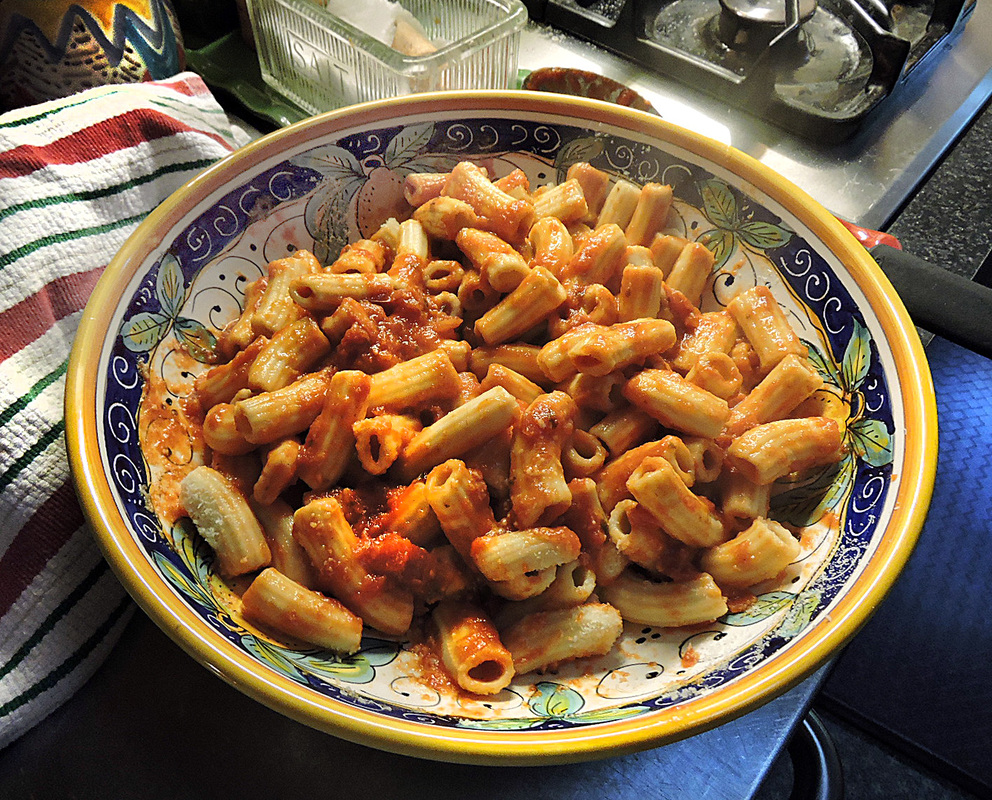 Lucas' and Lisa's Rigatoni, ready to be served Lessons Learned
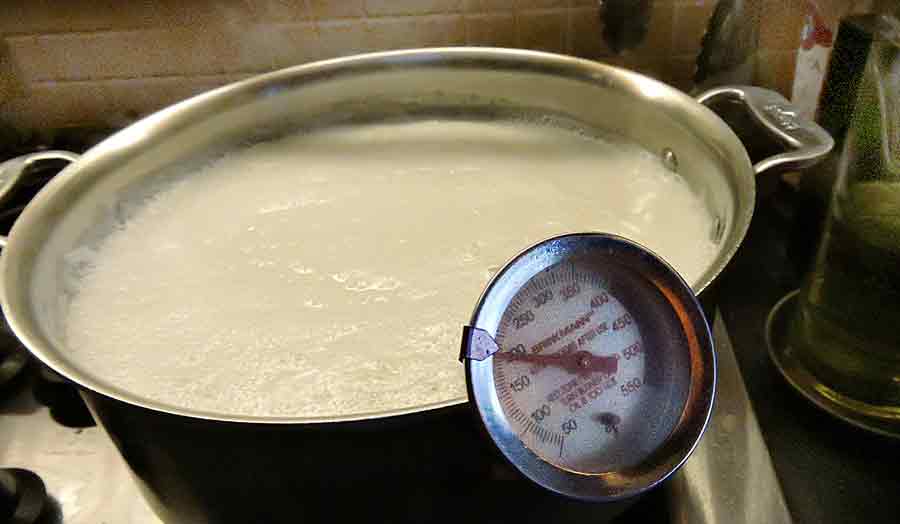
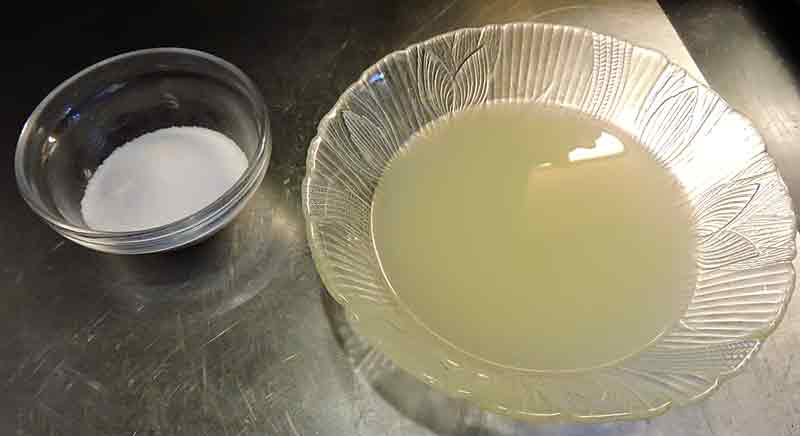
The next time we use the extruder, we'll adjust the recipe. The dough can't be as supple as when making fresh pasta with a pasta roller attachment, but it can be less dense than what we made with the KitchenAid recipe. I told Lisa that she should also use semolina pasta flour instead of all-purpose. I think this was part of the problem. Even a mix of all-purpose and semolina would work better. And my tip to Lisa was this: Don't rely on a written recipe alone when judging any dough. You have to use your eyes and feel the dough as it's being made. Whether the humidity is high or not giverns whether to hold back liquids or add more. I would make this dough with less eggs too. Many recipes for extruded pasta that is going to be dried do not contain any eggs at all (danger of contamination)--just water. As for the pasta they made, we all agreed it was a bit bland and a tad... well, doughy. As I'd expect from all-purpose flour. Perhaps it could have used more salt in the dough. The semolina would make it taste a bit more nutty, too. So, we'll report the next time Lucas and Lisa make extruded pasta and let you know how it went. Ciao and buon appetito! --Jerry Finzi You can also follow Grand Voyage Italy on: Google+ StumbleUpon Tumblr Copyright 2016 - Jerry Finzi - All Rights Reserved 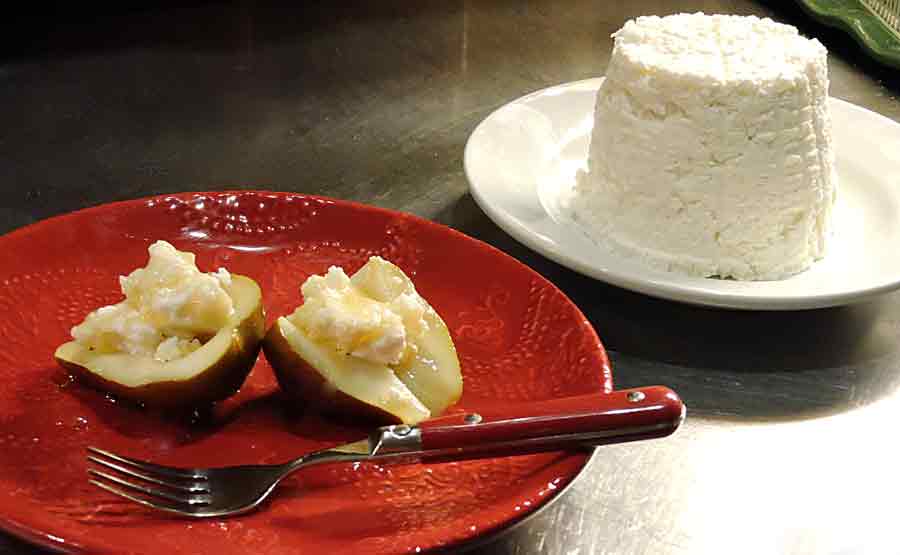 Yes, that's it in the photo above. Lisa's wonderful, home-made ricotta cheese tucked on top of Seckel pears with honey drizzled on top. There is nothing like the taste of home made ricotta, and Lisa discovered how simple it is to make.... Here's how: First, heat up one gallon of whole milk in a stock pot to 200 F. Next, measure out 2/3 cup of lemon juice (if using fresh, strain well) and 3-4 tablespoons of salt (depending on how mild or salty you want the ricotta) and set aside. Lisa tells me you can substitute the lemon juice for 1 teaspoon of citric acid if it's available.
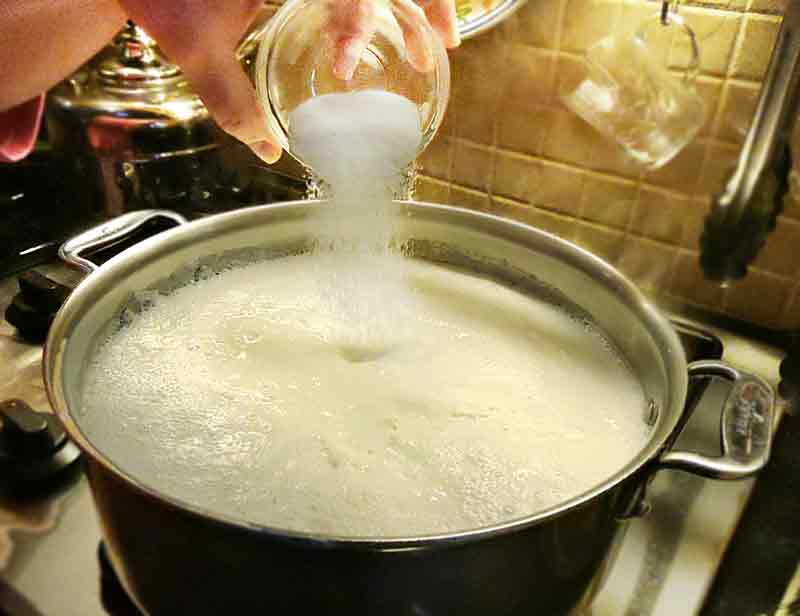
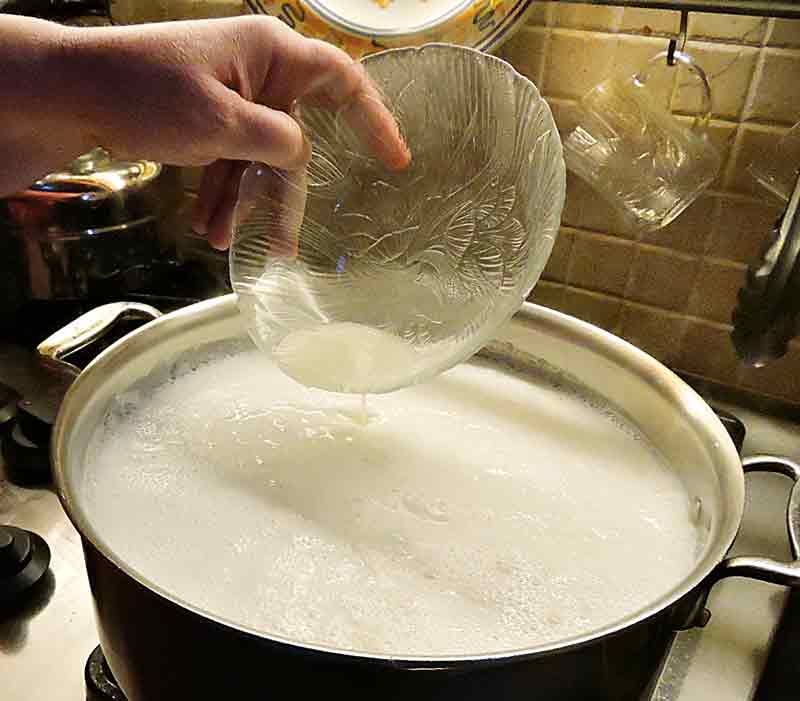
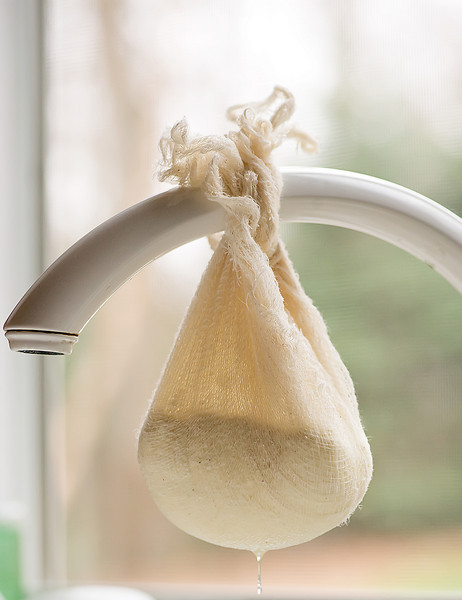
Once the milk is up to temperature, add the salt and lemon juice and stir well for 1-2 minutes. You will see the curds start forming within a minute or so. Turn off the flame and set the pot on a cool burner and let sit for 10 minutes. 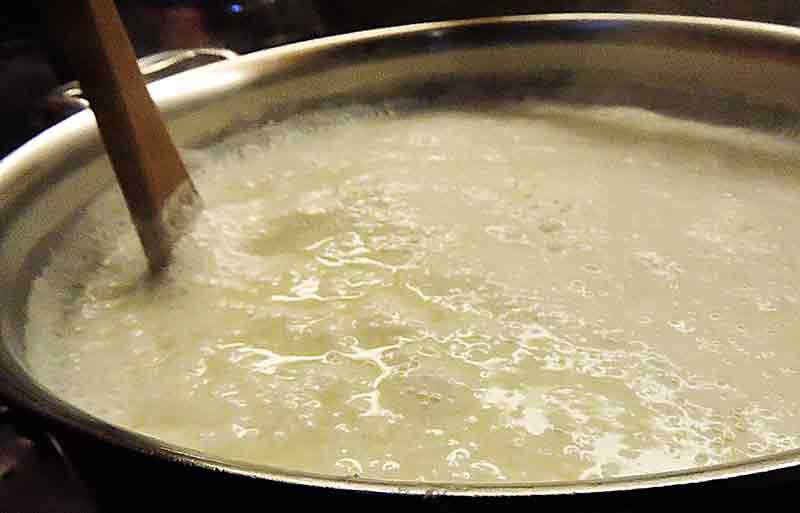 Curds form immediately after adding the salt and lemon juice. After the ten minutes is up, it's time to strain the curds from the whey (the liquid left behind) and place the cheese into a mold of some sort. Lisa uses professional cheese molds she purchased on Amazon, but you can also place your curds into a large mesh strainer over a bowl, or into a fine weave cheesecloth lining a small bowl or measuring cup. (If using cheesecloth, you need to tie it into a sort of sack using twist ties, then hang it somewhere to drain). You should get about 4 cups of ricotta from this recipe. 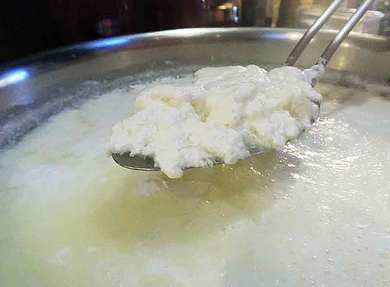 Fully formed curds after a 10 minute rest.
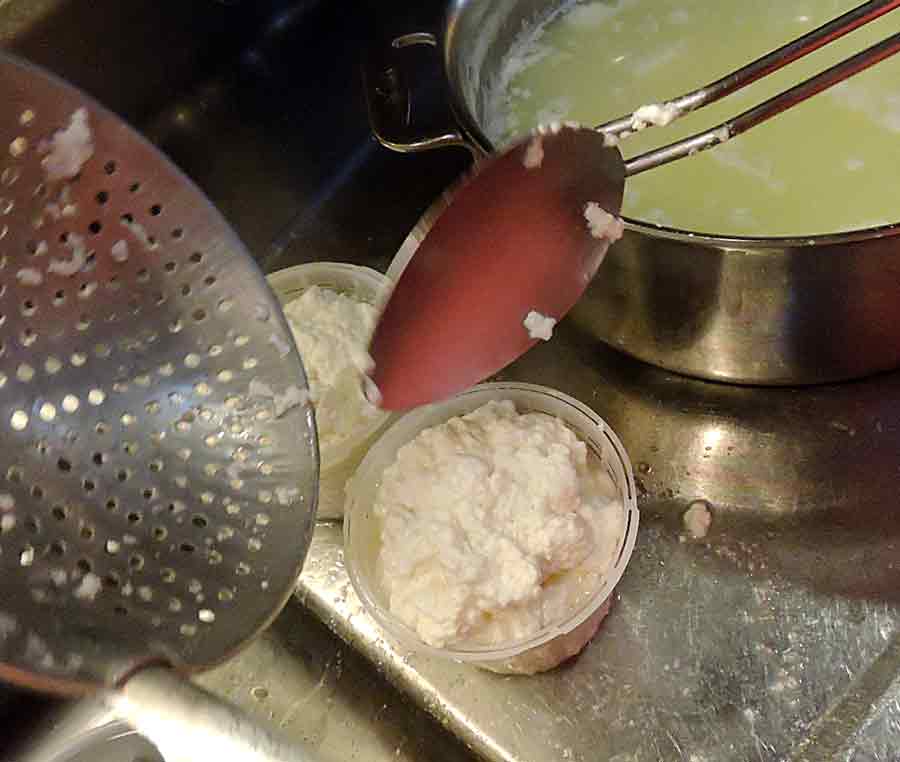
Lisa placed the curds into her cheese molds and left them on the edge of our stainless steel sink's draining ramp. She also uses a small meat pounder on top to help gently press the whey out. 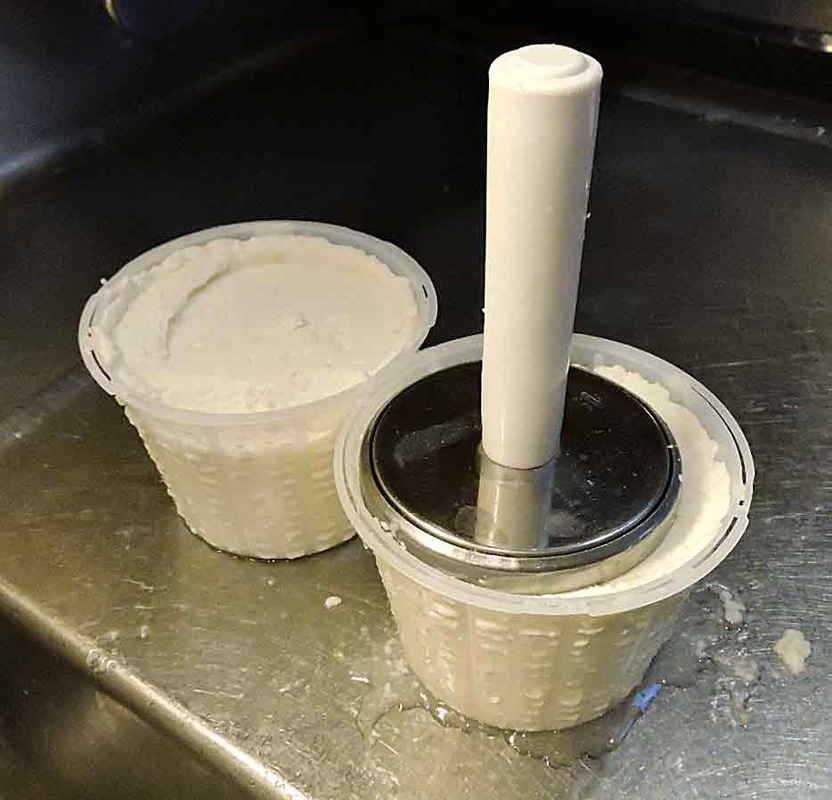 The cheese molds draining After several hours of drying (or overnight if you prefer), you will have a delicious, creamy, luscious ricotta to enjoy in recipes, on pizza, with fruit or on a bagel for breakfast. The taste is amazing--and this is coming from someone who never liked ricotta--that is, until Lisa starting making it fresh. Boun appetito. --Jerry Finzi If you decide to try making your own ricotta, please check back and tell us how it tasted. Ciao! 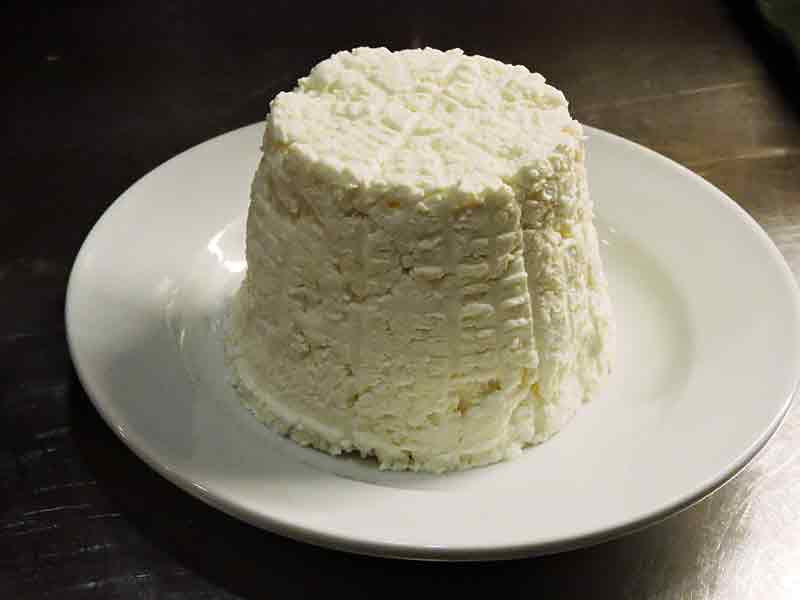 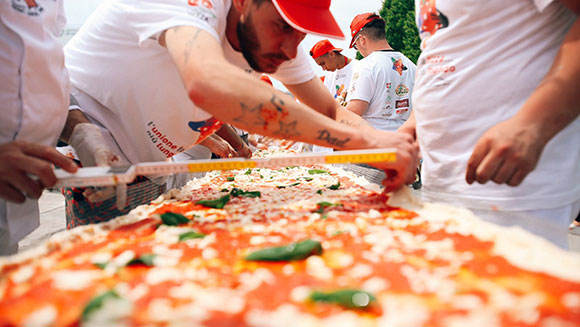 Along the seafront of Naples in Italy, 100 chefs collaborated to create a 1,853.88 metres (6082.2 feet / 1.15 miles) long Neapolitan, which Guinness World Records has just confirmed is officially the Longest pizza ever made. The recipe for record-breaking success included 2,000 kg of flour, 1,600 kg of tomatoes, 2,000 kg of fiordilatte cheese and 200 litres of olive oil - all of which was sourced from local suppliers in the Campania region, ‘the home of pizza’.... READ MORE HERE... 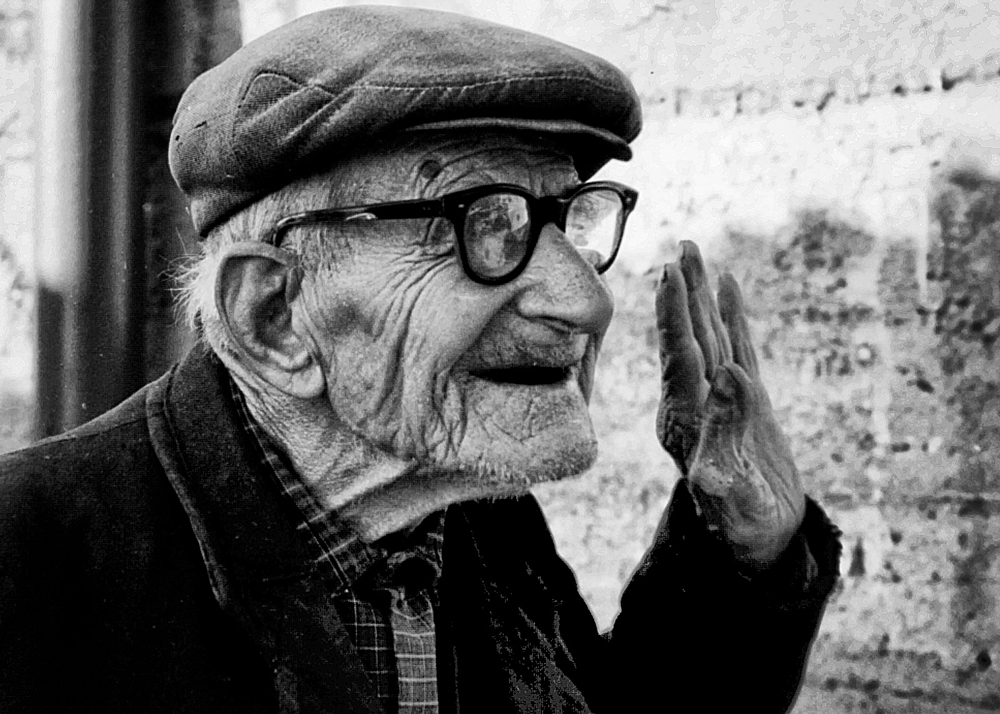 photo by Sergio Pani As my blog article, Italy, Healthiest Country in Europe tells, Italians are already pretty healthy, but there's a lot more to the story... It's been recently reported that there are over 19,000 Italians over 100 years old today still living La Vita Bella. And apparently, Italians are getting healthier, because the number of centenarians has tripled in the last 15 years. Italy has the second highest life expectancy in the world, too--at 83 years young! According to the World Health Organization, their long life is filled with family and friends around them, a great, healthy Mediterranean diet and beauty all around them. These are not feeble types stuck in an old folks home... many live their own lives in their own homes. Europe's oldest woman is Emma Moreno, at 116 years old. (Read about Emma HERE). She still lives on her own in Verbania in the Piedmont, is a bit flirty to handsome male visitors and loves to sing. There is also a town called Montemaggiore Belsito in Sicily that has nine people over 100--in a small population of 3500 residents. 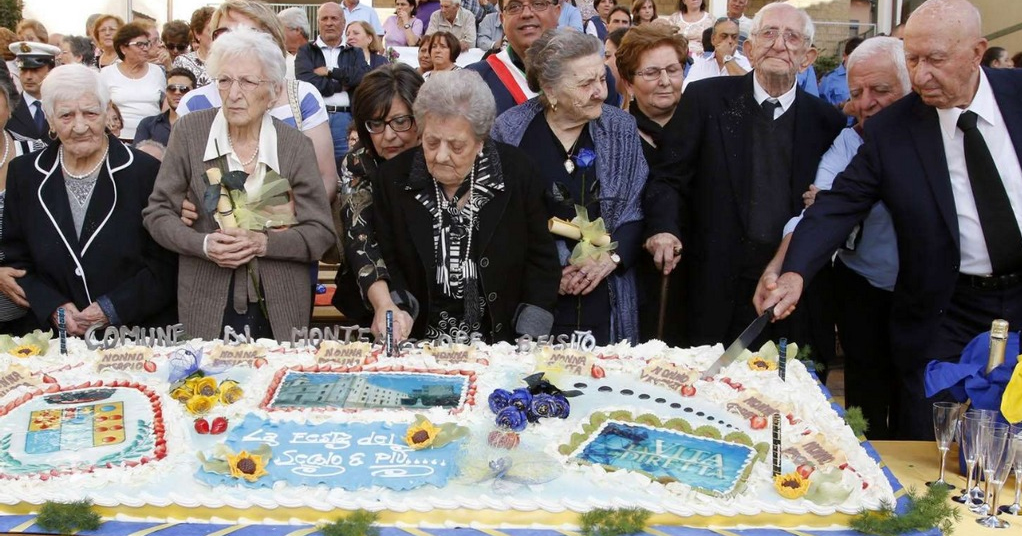 Centenarians of Montemaggiore - Photo by Antonio Parinello 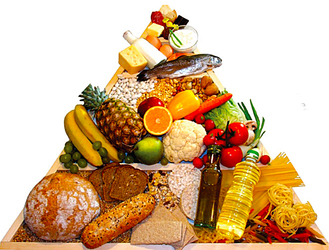 Mediterranean diet food pyramid Mediterranean diet food pyramid There is another town in Campania called Acciaroli where 300 out of a population of 2000 are over 100 years old. (Read about Acciaroli HERE).
Scientists call hotspots for longevity Blue Zones, and one of the most studied is the island of Sardinia. Apparently, Sardinians carry the M26 genetic marker, which is tied to long lives, at rates higher than the general population. Scientist believe that their gene pool has remained "undiluted" mainly because of their isolation--living on an island offers less genetic variety. Sardinia has 10 times more centenarians per capita than in the United States. The other factor is their lifestyle... traditionally, they grow and harvest much of their own food, hunt and fish, and eat what they catch. The Mediterranean diet affords lots of antioxidants which keeps them heart-healthy. They tend to eat less red meat, more fish and vegetables and drink red wine--yet another source of antioxidants. When they do eat meat it's usually pork, goat or lamb. Their fats are natural--lard and olive oil. The cheese they eat comes from sheep and goats rather than cows, which is much better for overall digestion. A sedentary lifestyle is unheard of, and in fact, Sardinia's rugged landscape requires hiking to get somewhere--people never merely walk. This heightened activity alone adds to the robust health of these people. They also take afternoon naps, have small breakfasts, large relaxing lunches and moderate suppers. Some Sardinians even claim that their windy environment along with the magnetic rocks that make up the island somehow put energy into their bodies. In the end, one of the more important factors to increased longevity in Italy might be the relaxed attitude toward life itself. There is less stress perhaps due to the widespread attitude of "domani". Yes, there's always tomorrow. And the tomorrow after that. And the one beyond that one. Italians look at time as a river that flows downstream without stopping. Why fight what you can't stop? Flow with it. The river of life can be a long one indeed... --Jerry Finzi Please, stop by our SURVEY and spend 60 seconds telling us how we could make our blog better! Grazie! Copyright, 2016, Jerry Finzi/Grand Voyage Italy - All rights reserved You can also follow Grand Voyage Italy on: Google+ StumbleUpon Tumblr 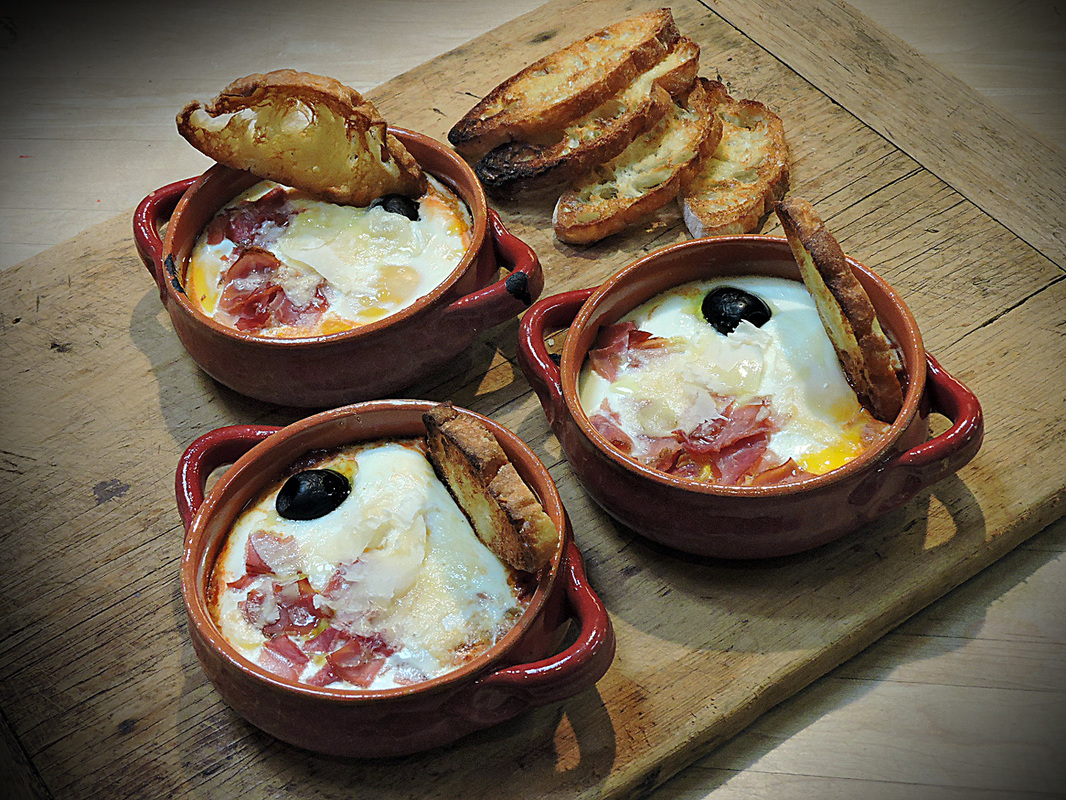 Here's a very easy and quick recipe I threw together for Lisa's birthday breakfast last Saturday. I've seen recipes for Eggs in Purgatory before, but wanted to put my own spin on it... I call this recipe Eggs in Limbo, because they baked on top of--and not in--a tomato sauce. I didn't like the way other "Purgatory" recipes usually poach eggs directly in tomato sauce in a large saute pan, and then need to be scooped out and portioned into plates when done--it's a bit messy. So, I figured I'd make individual casseroles for "We Three" (our name for our little famiglia) to provide a neater presentation. I bought these small Italian casseruola a while back and thought they'd be perfect vessels for baking the eggs. You can use any small oven safe casserole for this recipe.
Ingredients 2 eggs for each individual casserole 2 thin slices of Speck or (Boar's Head brand) Prosciutto Piccolo (per portion), cut into 1/2" x 1" strips Tomato sauce of your choosing (I used my basic pizza sauce recipe) Shaved Parmigiano Reggiano for topping Large, pitted black olives for garnish (Imported) toasted, sliced ciabatta bread for garnish Directions
The results were simple and tasty. Lucas put way too much black pepper on his for my tastes (he sure loves things picante). Lisa thought it was a perfect birthday breakfast.... Boun appetito! --Jerry Finzi Please, stop by our SURVEY and spend 60 seconds telling us how we could make our blog better! Grazie! Copyright, 2016, Jerry Finzi/Grand Voyage Italy - All rights reserved You can also follow Grand Voyage Italy on: Google+ StumbleUpon Tumblr 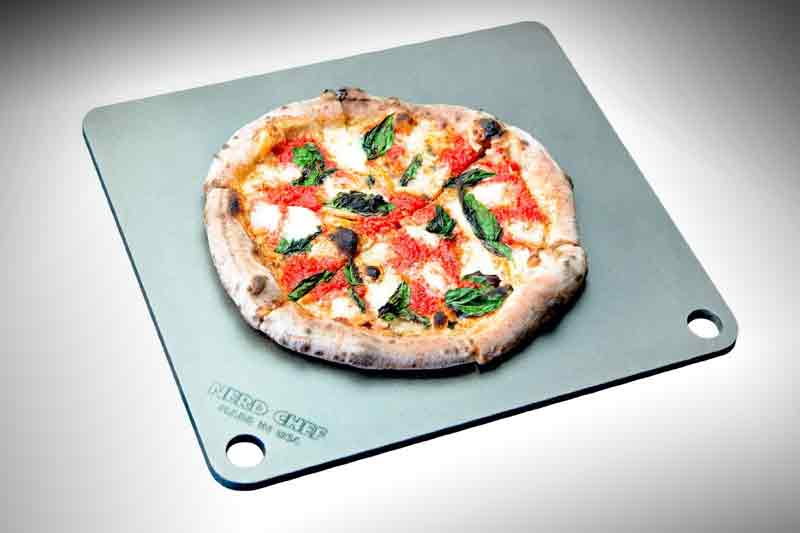 As you might have read in my post, Pizza Woes: New Wall Ovens and The Learning Curve to Make Perfect Pizzas, we have new double wall ovens--from Kitchenaid... with a conventional oven on the bottom and a convection unit above. Since we got them I've been having problems getting enough heat to bake my pizzas properly--and quickly. I've narrowed the problem down to a simple fact of physical science: Our old oven had a 50 amp breaker and used almost 44 amps of electric power to heat its exposed thermal elements. The new ovens require only a 40 amp circuit breaker for its lower covered heating element and uses only 33 amps of power. The problem is the old ovens heated faster and more intensely. The new ovens take a long time to preheat and seem to fluctuate as much as 80 degrees as the thermostat tries to keep the oven at the temperature I've set on the control panel. The rear of the ovens are also 25-35 degrees hotter than the front... this is due to the fact that the glass on the doors is one of the largest I've seen on wall ovens.. that much glass simply does not hold the heat as much as an oven door with a smaller window. So, I've tried a few things to help my pizzas bake faster and more evenly. First I tried a double stone technique--where you place one stone under your pizza and another on the rack just above the lower one. Supposedly this is supposed to radiate heat downwards as well as upwards toward the pizza. I didn't see any difference. Since Lisa doesn't like pizzas that are too dark on the bottom, I usually make pizza on my newer, lighter colored, less seasoned stone. Ok, so I tried using my darker, more aged stone. It helped a bit, but my normal bake time for a pizza placed right on the stone (I use parchment underneath the dough) still were taking almost 20 minutes at 550 degrees F to bake properly. My old oven only went to 515F and finished a pizza baked without a pan in 3-5 minutes! For my pan pizzas I often use a silver steel half sheet pan--a heavy commercial one. I've always gotten great pan pizzas in 15 minutes at 475 degrees F from these pans--the pan placed on the preheated pizza stone. With the new ovens, the bottom of the crust took forever to crisp and brown up. So, I tried changing pans and got a dark colored heavy sheet pan. This worked pretty well. My times came back down to 15 minutes... but sometimes needed a minute on broil to finish cooking the toppings. Ok, I could live with that--pan pizzas are back on track. Now, back to on-the-stone pizzas... I tried the upper oven's convection feature only to find that the rear of the crust burned--a charcoal tasting black. Not good. This seemed to happen no matter what rack I put my pizza stone on--above the rear convection fan or at the bottom. I typically bake rectangular pizza shapes so turning the thing halfway through baking would be awkward and potentially dangerous. 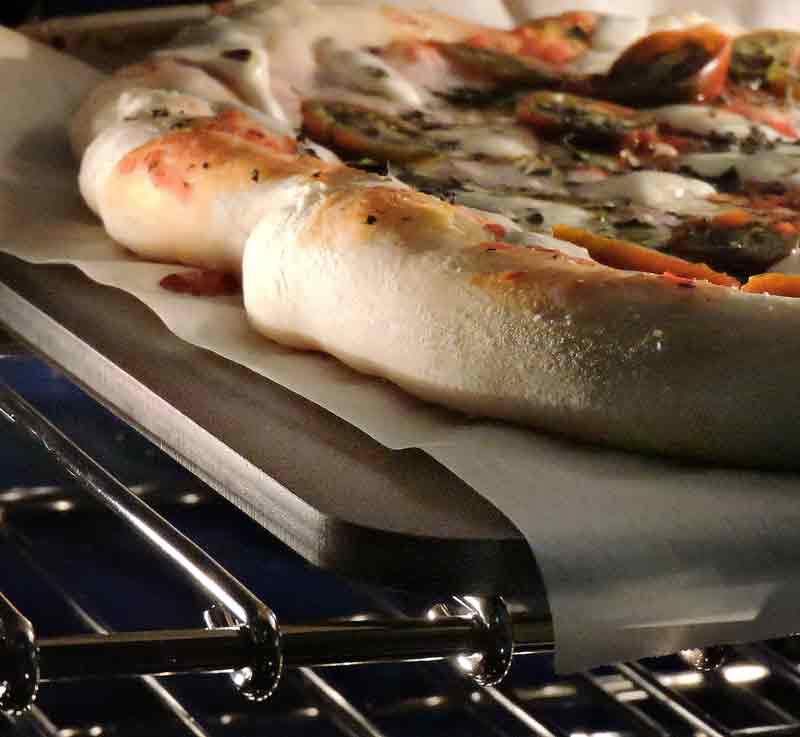 The pizza on the steel after about 2 minutes The pizza on the steel after about 2 minutes A Solution (or rather, a compromise) Well, I think I've found a secret weapon to solve some of these problems. The pizza steel. It was a bit hard to decide on the perfect one... most are made of a carbon steel and have to be seasoned. Most are also smaller than a standard 14" x "16" pizza stone, too. The Nerd Chef Pizza Steel was the right size but a bit expensive at $80 on Amazon. I ordered one and got right to pizza making... 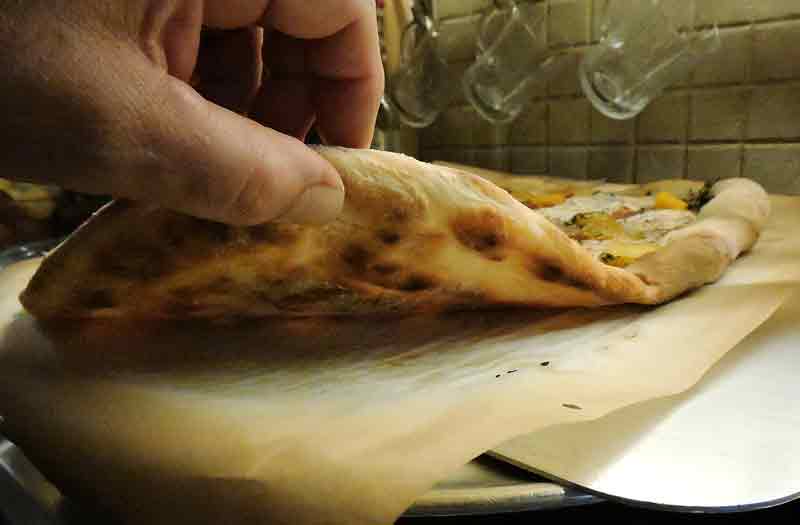 Great dark blotches, crispy bottom First of all, this steel is heavy. I mean HEAVY. I think it's about 25 pounds. The steel isn't black. It's a dark grey, textured steel. It didn't need seasoning. Here's the science behind it. All things transfer heat at different rates. Take air, for instance. Air is terrible at heat transfer. That's the reason we can momentarily place our hand into a very hot oven and not get burned. But touch the metal of the oven rack and we'll get a serious burn. The heat transfers from the metal very, very fast. This pizza steel transfers heat about 20 times more efficiently than a ceramic pizza stone. This also makes it heat up to temperature quicker--and stay at that temperature with less fluctuations. 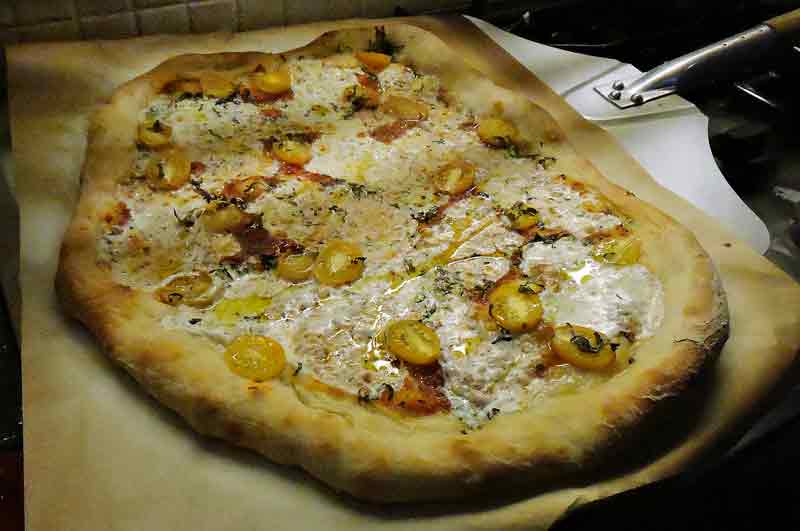 Those are Olivette Juane heirloom tomatoes on top How did it work? Well, you be the judge. The photo above shows the finished product... The oven was pre-heated for 45 minutes, the temperature was set to 550F, and I got a a 5 minute pizza! The crust was crisp. It gave a nice thud when I flicked a finger under it. My laser thermometer showed the temperature was a bit more even from front to back... perhaps only a 15-20 degree difference. I used parchment under my dough... sliding it off my wooden peel along with the pizza as I slid it onto the steel. No need to oil or season the steel. I'm sure it will stay cleaner this way too, as the parchment keeps any spills from getting onto the steel. I did two pizzas, one right after the other with about a 3 minute gap in between. As I prepped the second pizza, the steel had time to get back to temperature again. (Pizza stones tend to cool down if you do one pizza after the other).
So, problem solved. I still am not crazy about my new ovens, but at least I've found an acceptable workaround. BTW, if you decide to get a pizza steel, just be careful about never touching it when it's hot. Give it a very long time to cool down and perhaps crack the oven door open a bit after you're done making your pizza. This thing is so heavy that I'm leaving it in the oven even when cooking other things. I'm going to try it for bread also, but I'm thinking it might brown the bottom of a bread a bit too much. I'll let you know... Ciao! --Jerry Finzi UPDATE: Since I originally wrote this, I have used my steel at least once a week, I have some other observations...
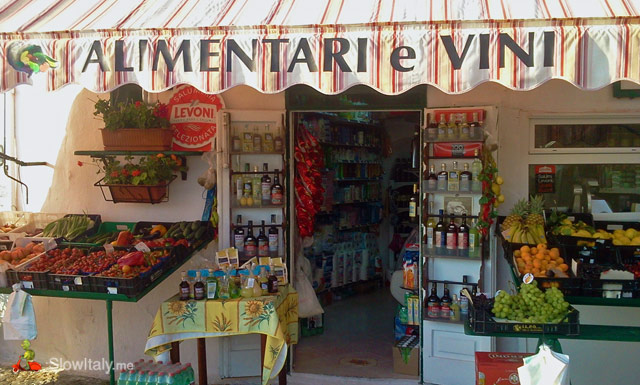
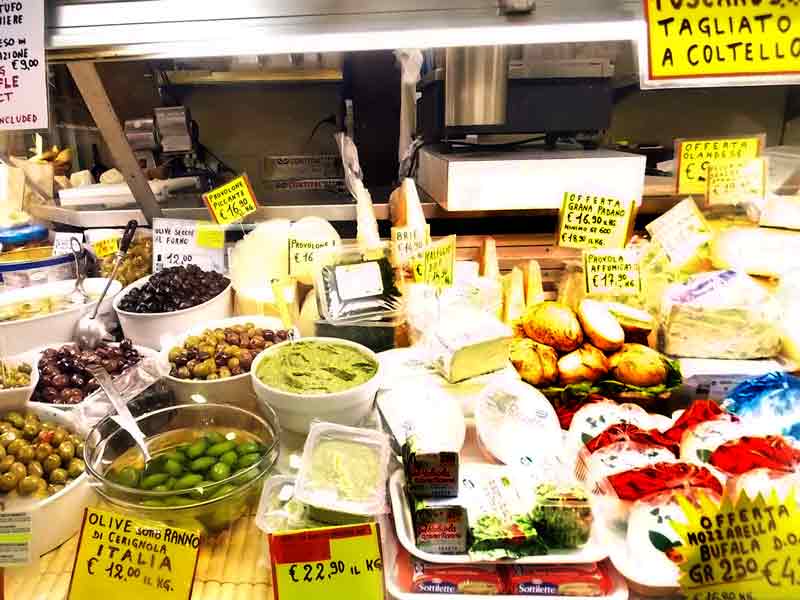
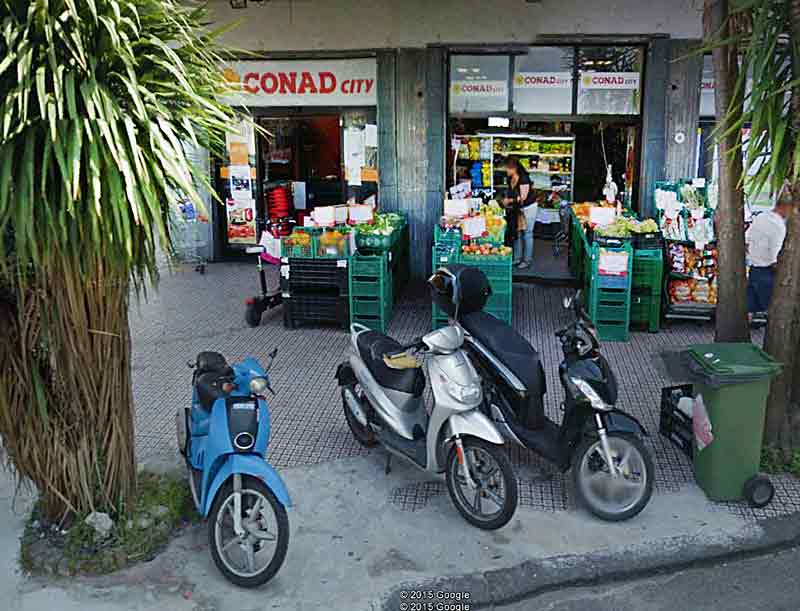
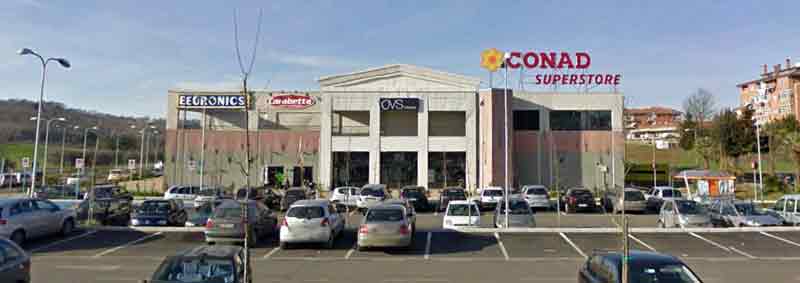
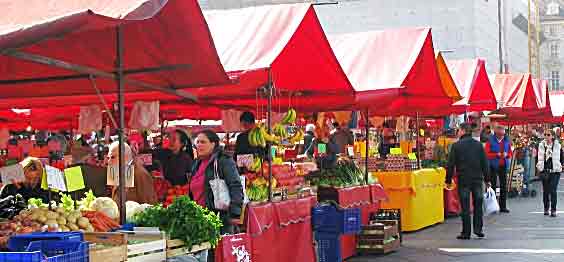
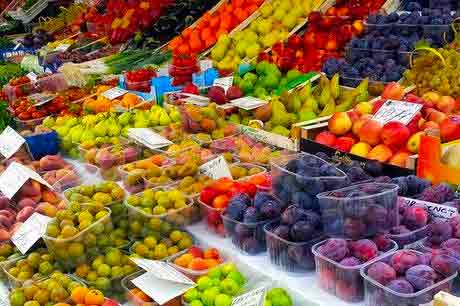
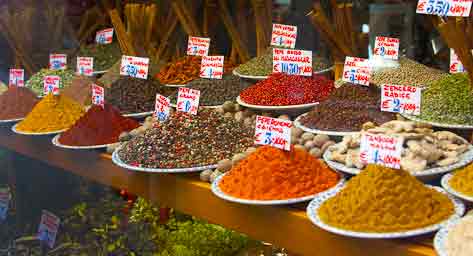
Please, stop by our SURVEY and spend 60 seconds telling us how we could make our blog better! Grazie! You can also follow Grand Voyage Italy on: Google+ StumbleUpon Tumblr 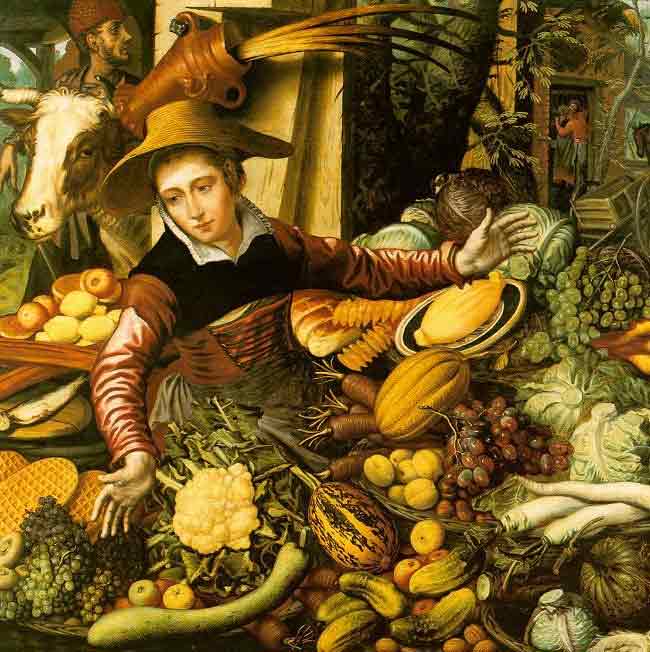 Abbondanza! When you travel to Italy, there are a few choices of how to plan your accommodations, some limiting your options for meals, while others leave a lot of options open, especially if you would like to try cooking for yourselves in Bella Italia. First, there's staying in hotels, which usually (but not always) include cornetto and other pastries, jam, honey and espresso breakfast, and then eating dinner in their (typically) over priced ristorante (if they even have one). Perhaps you'll book yourself into a small and cozy Bed & Breakfast, where you normally receive an Italian style breakfast, or worse--a colazione Americana (American Breakfast)--a poor impersonation of the egg and bacon breakfasts that you are used to--picture scrambled eggs sitting out all morning, fatty, greasy bacon and the packaged, hard dry bread that Italians consider "toast". 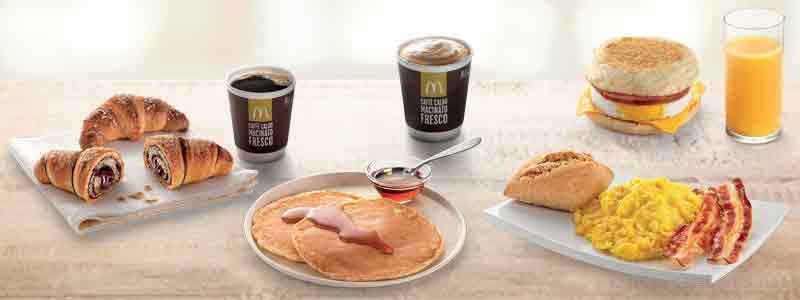 Yes, there are McDonalds in Italy... Look the other way and pass it by.  Ok... Now THAT's a real colazione! But there is a third option... staying in an apartment, house or an entire villa, or an agriturismo (a suite or room at a working farm), each with a full functioning kitchen. Yes, you can cook your own meals whenever you're inspired to do so. It's these options that afford you the most flexibility. But of course, you'll also be eating out... when you discover that little, homey, non-touristy trattoria in the back streets; having sweet pastries and espresso while standing in the local bar/tabacchi like a real Italian (remember, they are more like snack shops in Italy); and eating pizza in a ristorante tourista just because it's right across the street from the Colosseum (yes, we did it). Or perhaps you feel a need to say you had a Big Mac in Rome (don't do it!) or you just have to have a foot long at an Italian Subway. (ugh) Eh, to each his own. You might even want to check out a gigantic slice of pizza at Spizzico--where one slice is a quarter section of a whole pie--an Italian fast food pizza chain owned by parent company Autogrill, a fast food restaurant you might want to stop at while driving on the large Autoroutes in Italy. Hey, I hear their panini aren't bad. But other times you'll be buying pastries, a special blend of coffee, some fresh ricotta and honey, and buying some of those multicolored eggs with deep orange yolks (Italians call that part "red") in the mercato... just so you can sleep in a bit and make your own breakfast the nest morning. Or simply stocking up in the local market so you always having a backup plan--picnics and bread & cheese snacks on the road, or cooking at "home" with some new found authentic Italian ingredients: local pasta, tomatoes and veggies, prosciutto, cheeses, sausages, breads, wines and balsamic. We saw delicious produce and ingredients everywhere we went--even the supermarkets have amazing choices. Remember, you can do some culinary exploration while in your own Italian cucina (kitchen). Suggestion: a simple frittata with a new type of cheese, a sausage you never heard of or using those odd green tomatoes you saw at the market. And of course, there's always the breads. Chop some olives, tomatoes sprinkle with sea salt and olive oil and top off your bread for your very own bruschetta! Having a home base is a wonderful way to expand your culinary horizons while using the amazing ingredients from the region you are staying in. As a plus, if you stay at an authentic agriturismo (a working farm that also rents rooms or apartments), you might be able to take cooking classes on how to make pasta, make cheese, cook regional recipes and more. Your first day in Italy will be tiring, but as you travel toward your apartment, you will need to stop for basic supplies--if it's not to late in the day. Before booking your accommodation, ask about the kind of kitchen equipment they have for you to use (some might have a cooktop but no oven), and how much basic pantry items they keep in the cupboards. For example, in one agriturismo apartment we rented in Tuscany, they had coffee, tea, sugar, spices, salt, pepper, olive oil and even had little breads, pastries, honey and jam (the owners live there and farm the land). It was easy to have a snack the first night, make breakfast the next morning and other meals thereafter. They really had a complete kitchen and pantry. 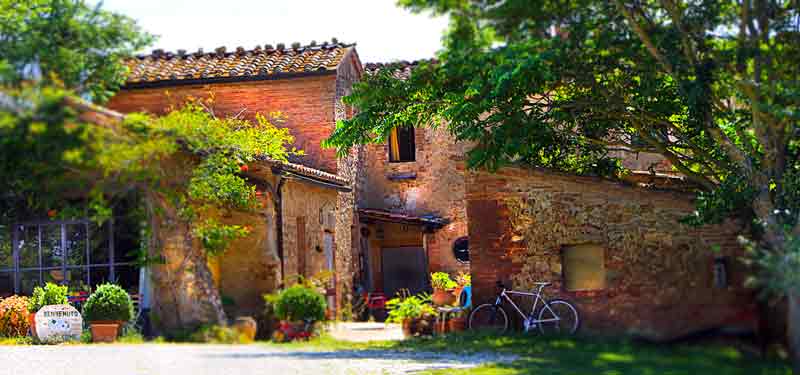 Agriturismo Podere il Casale near Pienza, an organic working farm: cooking classes, pasta-making, cheese-making, pigs turned into prosciutto, sheep for their cheese and more. 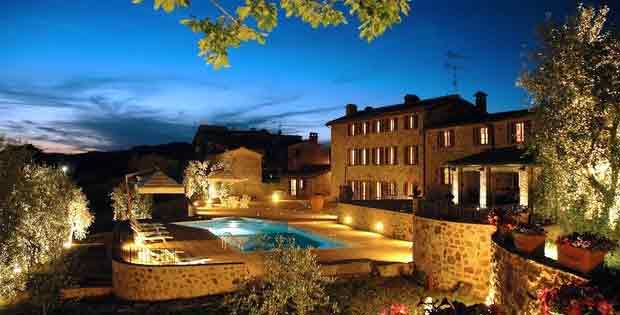 Agriturismo farm experience or just a hotel? You decide. Agriturismo farm experience or just a hotel? You decide. Beware: Phoney Agriturismos Yet, in another of the new breed of overdeveloped faux agriturismo, created by investors who don't live or work there, you will find little authenticity, no hands-on farm experiences, very little history, young and handsome or pretty smartphone-clinging staff (who live in the nearby cities), cheap tourist wine, terrible olive oil, and an overpriced on-site cafe. Everything is extra. The wine, the oil, the soap for the washer. In Mormoraia, an agriturismo we rented outside of San Gimignano, as chic and stylish as it was, they didn't have salt, pepper, coffee, tea, oil, ice trays, a cutting board or even a single good chef's knife. (The TV didn't even work--and no one seemed to care). The place produced their own wine and olive oil--but they didn't think to supply small samples for the kitchens in their apartments so guests could cook with them. These types of places are built by a recent wave of out-of-region (or foreign) developers who buy up old farms and vineyards, renovate them to look pretty as a postcard, put fancy labels on their wine and oil, but are about authentic as a Brit wearing a "Kiss me, I'm Italian" T-shirt. I really emphasize due diligence on your part in researching beforehand--and reading all the reviews of an agriturismo you're considering. If you want to cook while in Italy, make sure your accommodations can handle it. Another tip... look at the photos people post on sites like TripAdvisor. If the agriturismo looks too clean and neat, if their are no dogs, goats, pigs, or kids running around, and if you don't see photos of the actual proprietors cooking and engaging with guests, it's more than likely a phoney-Bologna imitation of the real deal. Where to Buy Food If you have your agenda well planned ahead of time, you can use a tool like Google Earth or Google Map to find places to shop in the area. Zoom into the area you will be staying in and search for "supermarket" or "supermercato". Google speaks all languages. I did this before we left and put my custom Google pin maps on my Kindle and smart phone before we left. Stop at an alimentari (literally translates as "food") or even a supermercato. Here are the types of places you can stock up:
One more thing... small towns will have alimentari and other small shops with little or no signs. Often it's difficult to tell what type of shop it is. They will have metal roll-up doors that will more than likely be closed (either partially or all the way) from 12 - 3pm. Try to do your food shopping earlier in the morning to be certain to find the shops you need open. If need be, ask someone "dove si trova la (il) ______ più vicina?", (Where is found the nearest _________?") filling in the blank with the type of shop you need. Specialty Stores
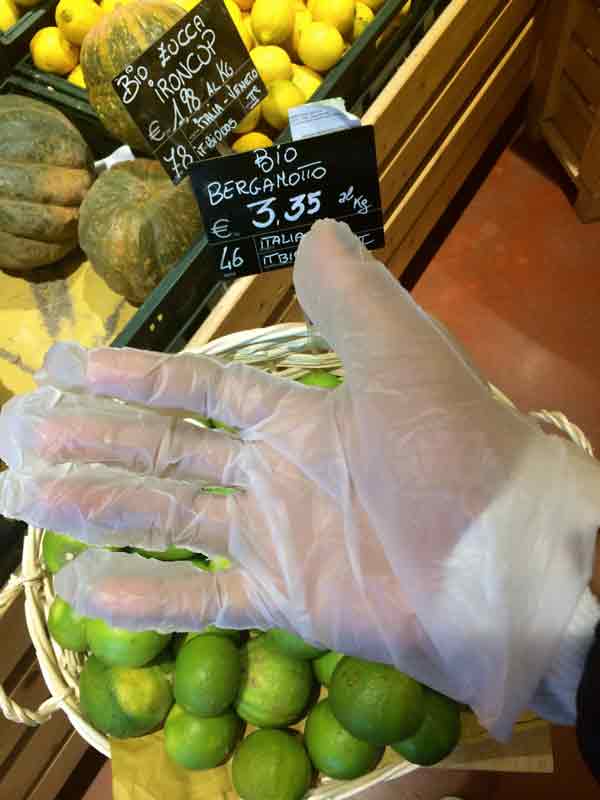
Late in the day (4-7 pm) is the best time to shop in boutiques or gift shops. A new trend in Italy is to put "-eria" at the end of a word to describe a shop. Yogurteria, Hamburgheria, Fruiteria, Disceria (for CDs), Vineria (wine), etc. 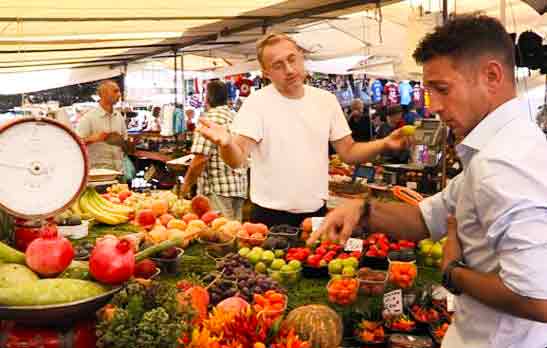 How to ask for what you need In Italy you will be dealing with the metric system... kilos, not pounds. Una etto (abbreviation of hectogram) is asking for 100 grams, 200 grams would be due etti, three... tre etti, and so on. I even asked for simple, "cento" and got 100 grams, which is about a quarter of a pound--about the amount of cold cuts for one or two sandwiches, or enough cheese for your lunch. If you want a wedge of cheese, hold out your fingers to how thick you want it sliced and say "Come questo" (like this). If you want thicker say "più spessa" (more thick), for thinner say "più sottile" (more thin). Point close to you for "questo" (this one) and point away for "quello" (that one). When thinking in kilos, think about half of what you would ask for in pounds. (A kilo equals 2.2 pounds). If you want about a pound, ask for a chilo (pronounced KEY-lo). In Italy, a kilogram is chilo. Half a kilo would be mezzo chilo. Be careful about these two... one quarter kilo is "un quarto chilo". Four kilos would be "quattro chilo". If you want to ask for something "to-go" you ask for "portare fuori" (literally, "bring out"). Remember that numbers for pricing are written a bit differently. Decimal points and commas are switched around... a leather jacket can cost €1.000,00 but never would cost €1,000 (that would be one Euro with an extra zero). A house might cost €1.000.000,67 (one million plus 67 cents... don't know what the 67 cents is for). A gelato might cost €3,50 (without the decimal point). Pantry Staples
I'll do a separate post on numbers soon. You definitely need to know how to say and hear numbers when shopping, in hotels, restaurants, taxis and trains. I hope you'll get a chance to do some food shopping in Italy... and don't miss the Italian supermarket experience. Soak in the differences, try to translate the names on boxes and cans, and enjoy trying to figure out those odd veggies...  It's called Cardi, or Cardoon and tastes like artichokes It's called Cardi, or Cardoon and tastes like artichokes Magia bene! --Jerry Finzi Please, stop by our SURVEY and spend 60 seconds telling us how we could make our blog better! Grazie! You can also follow Grand Voyage Italy on: Google+ StumbleUpon Tumblr Copyright 2016 Jerry Finzi/Grand Voyage Italy, All rights reserved 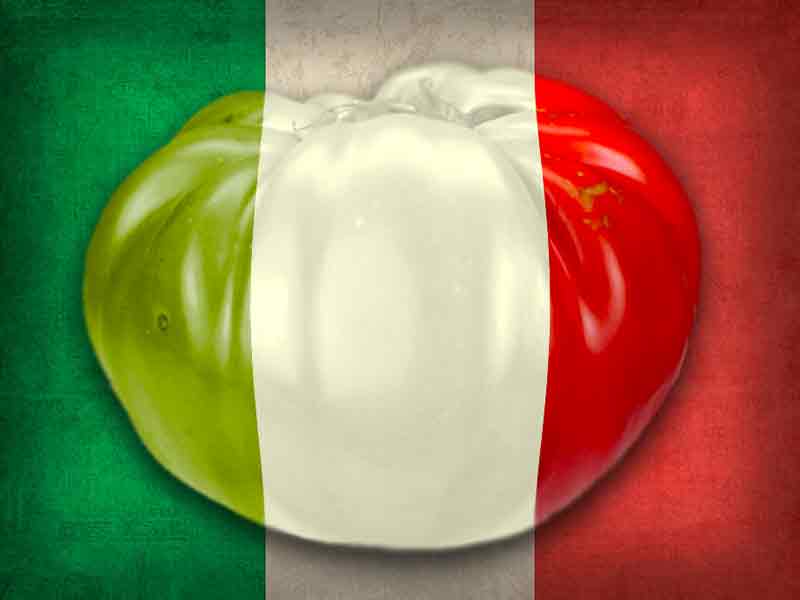 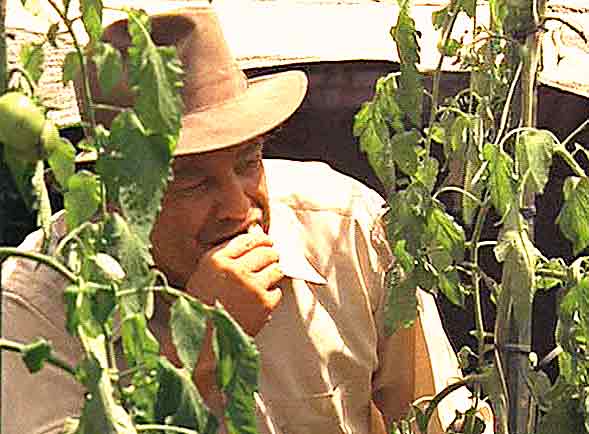 Don Vito living the life Don Vito living the life It's early May and if you look in my cellar right now you will find a couple of dozen young tomato plants under my grow light nearly ready to be planted out in my vegetable beds (within two weeks, after fear of frost is gone). My mind always fills with thoughts of tomatoes in this time of year... and hopes that there will be a good yield for our little famiglia... If I say, "tomato sauce" you think of Italian food, right? If I say "home grown tomatoes" you might think of Vito Corleone playing with his grandson in his garden in that final scene in his life. If I say "pizza" you picture a round crust with cheese and tomato sauce. The red color is essential. Some say that Il Tricolore (the tricolor flag of Italy) represents the hills of Italy with green, the snow capped mountains with white, and the blood spilled from the wars of independence by red. But others in la cucina Italiana would argue that the green is for pesto, the white for besciamella and the red for salsa pomodoro found in tri-color lasagna... or that the flag represents the simple but wonderful insalata caprese: green for basil, white for mozzarella, and the red for ripe tomatoes. In any case, you might say the red in Il Tricolore represent the true blood of Italy--the tomato.  Cirio started canning tomatoes in 1875  Wild tomato of Peru Wild tomato of Peru But how did the tomato become such a strong part of Italian culture? It is not indigenous to Italy, or Europe for that matter. The tomato was first "discovered" by the Spanish Conquistadors while exploring and then conquering the Americas. The tomato most likely originated in the Andes mountains of Peru and spread sometime in the distant past to most parts of South and Central America and eventually on up to Mexico. The odd thing is that the tomato became popular in Europe long before it came to be used in North America. Colonial Americans thought of the tomato as a poisonous plant, after all, it's a close cousin or Nightshade, a well know toxic vine, and in fact, the leaves and vines of the tomato plant are fairly toxic. The 1500s came with Columbus and other explorers introducing the tomato to Europe, but there was about 200 years of skepticism before the tomato gained acceptance there--again, it was thought one touch of a tomato on the lips would kill you. One likely catalyst for its popularity in Europe, especially with the wealthy and elite was the rumor that it was an aphrodisiac. The general population more than likely heard about this new fruit and saw that the Barons behind the castle walls were flourishing, not falling down dead. One can imagine that the trash middens where refuse from the castles, chateaus and villas were thrown became a great source of distribution for the tomato plant--everyone knows that tomatoes are very prolific--their seeds can spring up anywhere. Little by little, the peasants discovered gnarly vines growing wild with attractive red or yellow fruits were attracting wild life. "Why not give them a try? The birds, squirrels and rabbits aren't dying, after all." Presto... a free, easily grown source of vitamins and amazing flavor. It was easy to save seeds and properly cultivate a very large harvest from even a modest number of plants. The word tomato is derived from the Aztec word xitomatl, which when it got to Europe was shortened to tomatl. The French originally called the tomato, pomme d’amour (love apple) before calling simply la tomate. Perhaps they changed the name when the aphrodisiac claims failed to have any effect. In Italy it was pomi d’oro (golden apple) which today becomes il pomodoro. Tomatoes do come in a wide variety of colors, including golden yellow, but along with tomatoes, tomatillos also came from the Americas--many of which are also yellow. In Italy, the tomato more than likely prospered because of its near-tropical climate. The tomato can be grown all year long in tropical temperatures. The first time the pomi d'oro is mentioned by name in Italy was in 1548 in Tuscany. As far back as 1692, tomatoes were used as ingredients in a cookbook from Naples, but the author obviously copied details from Spanish recipes. It makes sense the Spanish had tomatoes first, after all, they backed Columbus's explorations--even though he was an Italian. In this way, Spaniards actually led the way, "teaching" Italians to fry tomatoes up with eggplant, squash and onions, and used the dish as a condiment on bread and with meats. The cuisine of Southern Italian peasants, who often lacked meats and other proteins on a regular basis, developed into a mostly vegetarian diet in which tomatoes and olive oil, spices and vegetables were and eaten with bread, rice or polenta. 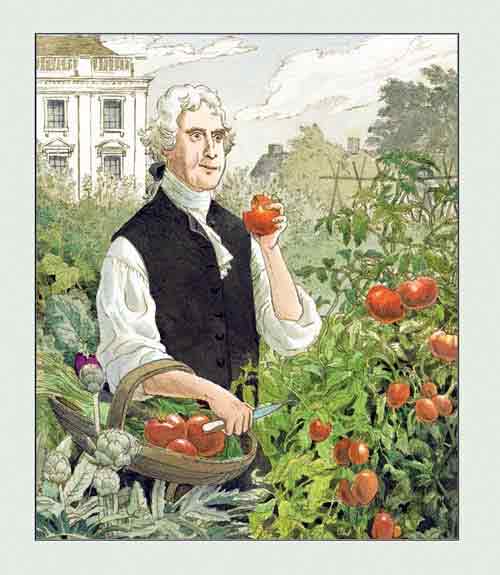 Jefferson knew a good thing when he tasted it Jefferson knew a good thing when he tasted it It took another 200 years for the tomato to become the national treasure is it today, but by the late 1700s, the peasants of Naples began to put tomatoes on top of their flat breads, creating something very close to the modern pizza. It gained popularity, especially with the elite of Europe and America taking the Grand Tour, and soon pizza attracted tourists to Naples, tempting them into the poor areas of the city to sample the new treat. Pizza was born. Soon after taking a Grand Tour himself, Thomas Jefferson, being an expert farmer and a culinary expert, brought tomato seeds back from Europe. He grew, cooked and wrote about the tomato. Slow but sure, people took notice of this special fruit. In the same time period we find the first recorded evidence of tomatoes used in sauces and preserved condiments and pastes. In the 1800s, in Naples a recipe was written about-- pasta al pomodoro, the very first mention of tomatoes being married to pasta. In 1889, after Italy became one nation, the King and Queen of Italy found it necessary to visit the former kingdom of Naples to appease the citizenry who disliked their loss of independence. Queen Margherita was bored with the same old French cuisine that they were eating everywhere they went--as was the custom in all of Europe. She called for the most famous pizza-maker in Naples, Raffaele Esposito, and commanded that he make pizza for her. He brought three types: pizza marinara with garlic, pizza Napoli with anchovies and a third with tomato sauce, mozzarella and basil leaves. She fell in love with the third one and Esposito named it after her-- Pizza Margherita. A short time later, the Queen sent her emissary with a thank you note, which still today hangs on the wall of Pizzeria Brandi, still run by his descendants. Pizza--with tomato sauce--was to become more popular than ever after the Queen's royal recommendation--the equivalent to Royal Yelp nowadays. If anything, emigration to the United States did more to increase the popularity of the tomato than anything else in history. Because of the climate in Italy, tomatoes became a big crop, even small farmers produced an excess of the sweet fruits. A need developed to preserve them, and to create new markets. The only foods that may be safely canned in an ordinary boiling water bath are highly acidic ones--coincidentally, tomatoes are naturally high in acid. Sun drying tomatoes and storing them in olive oil was also a proven way to preserve large stores of tomatoes, as long as no fresh herbs or garlic were added, the method a safe with a long shelf life. During the mid-1800s the science of canning started to develop and improve, allowing this new cash crop to find its way to distant markets. By the end of the 19th century Italians were already using tomatoes in their recipes and as a condiment. When Italians emigrated to America, they wanted to have products that reminded them of home... canned tomatoes filled that need, along with olive oil and other specialty imports. Italians at home and expats in American developed import-export businesses to give relatives and other their compagni jobs based on their new found wealth in America. In Italy, exporting companies were popping up, especially in the Naples area. By the time World War I rolled around, even the Italian Army experimented with canned ravioli, spaghetti alla bolognese and Pasta e fagioli, the inclusion of acidic tomatoes in the recipes aided in the cans' shelf life. Italian grocery stores stocked these products in Little Italy neighborhoods in New York, Philadelphia, Chicago, Boston and New Orleans. So, with the advent of this international distribution of peeled tomatoes (pelati), the ancient fruit finally came back to the Americas... not via its neighbor, Mexico, but the long way around, through Italy and Europe.
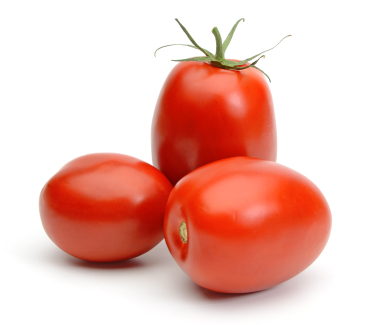
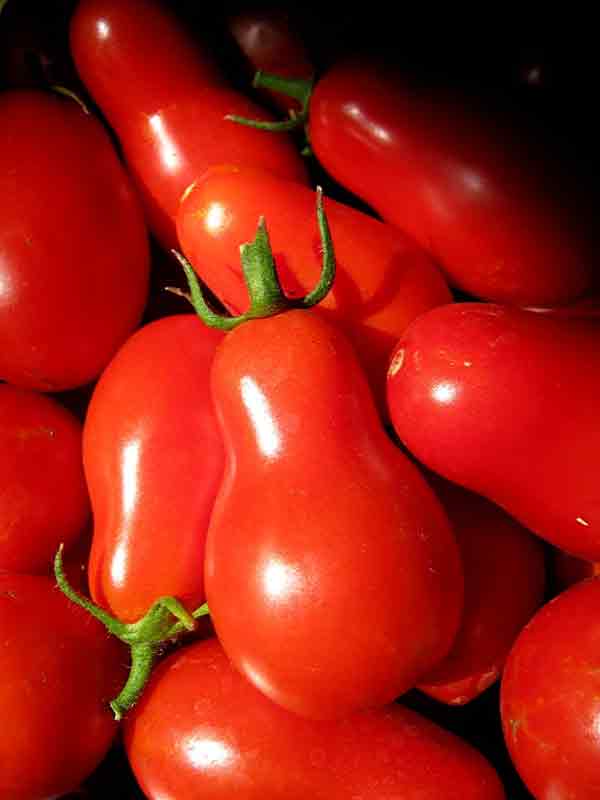
When growing tomatoes at home, you have to know if your variety is "determinate" or "indeterminate". The first grows and produces tomatoes only to a set height and then stops producing. The latter keeps on growing and producing fruit as long as the season is warm and long enough. 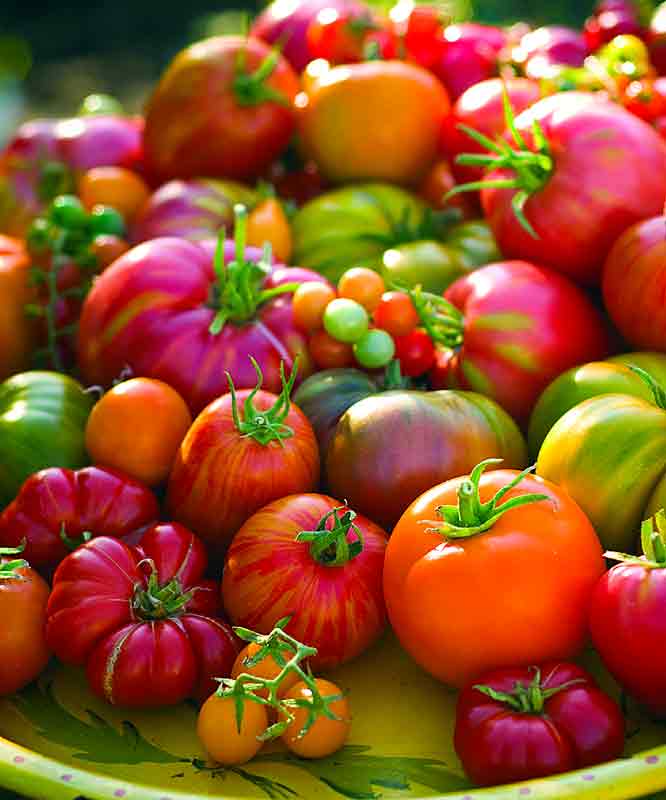 Assorted Heirloom Tomatoes  I grow Jersey Devil, a much sweeter, less acidic paste tomato I grow Jersey Devil, a much sweeter, less acidic paste tomato The best known tomato for canning became a plum shaped variety grown in the San Marzano region, near Naples. It's no small coincidence that this is in Southern Italy, where 80% of Italian immigrants came from. San Marzano became the go-to tomato for canning over 120 years ago, and is still the primary tomato used in canned tomatoes--and even for the production of sun dried tomatoes. The San Marzano tomato even has DOP protected status by the European Union (look for their seal on a can to make sure they are the real deal). The first Italian cannery was built in 1875 by Francesco Cirio, an early supporter of the San Marzano tomato. His company picked, peeled, packed and shipped canned tomatoes all throughout Italy--and later to America. The reason for it's success is not because it's the best tasting tomato... it's simply because it was developed and hybridized from three other varieties which made it withstand mechanical harvesting techniques put in place in the late 1800s to satisfy the needs of the growing canning industry. Sort of takes the romance out of thinking the San Marzano is "the best" Italian tomato, doesn't it? No great loss. Truth be told, the San Marzano is so acidic that all great Italian chefs know it needs a handful of sugar to offset the overly high acidic content. Lucas and I had an "artisinal pizza" once in a town near us where the pizza chef swore he used nothing but "the best San Marzano" imported tomatoes as his sauce. I could tell. By the end of the meal our lips were burning. For some really sweet tomatoes, think Heirloom... 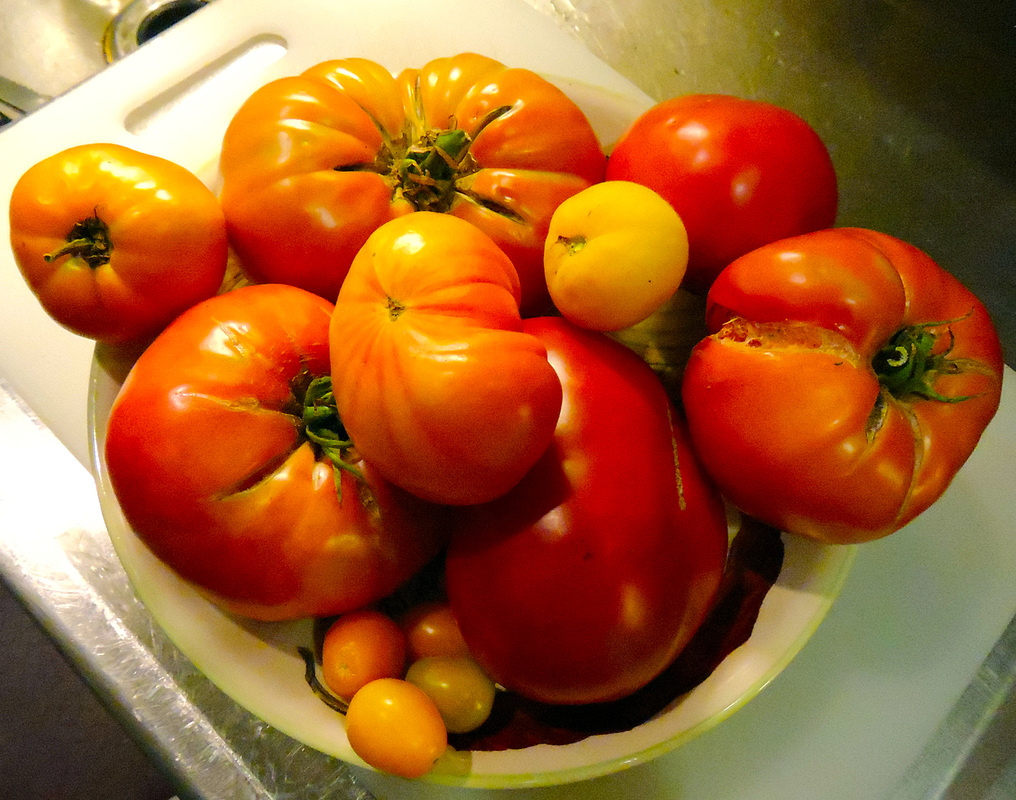 A morning's harvest from our garden last season Growing Your Own Heirloom Tomatoes It's fairly easy to grow tomatoes from seed, but a simpler way to get started growing the amazing variety of tastes is to buy heirloom plants in the spring at your local nurseries. Stay away from anything labeled "hybrid". You cannot save seeds from a hybrid tomato--it won't look anything like the mother fruit you took the seed from. Many garden centers nowadays offer Heirloom varieties that you can plant and get a head start on, with the benefit of saving seeds from your biggest and best tasting fruits so you can continue to grow them again year after year. Growing heirloom tomatoes can become part of your family heritage. If you purchase young heirloom plants, buy and plant them just after the danger of frost in your location. Here's a LINK to help you find out the best time for planting based on your zip code in the U.S.. Now, how to plant... First, make sure you are planting in ground that is tilled nice and fluffy. Make sure you have amended it with some nice organics... I like a mix of peat moss (to hold moisture) and compost from my own compost pile. You can buy compost to use. Stay away from fresh manures... they will burn the plants. You can use any number of organic or non-organic plant foods that have chemicals balanced for growing vegetables that grow fruits. As for planting, here's a great tip. Tomatoes will grow roots all along their stems if you let them. With young seedlings, pull off the lower leaves and plant deeply. If I have 12" tall plants, I'll plant them with about 2/3 under ground. This gives them a better start--allowing more roots to grow which will supply more nutrients to your plants--and fruits. I grow my tomatoes upwards onto "quad-pods"--sort of like a four legged tripod. You can make them out of wood or bamboo. As the plants grow, trip off side suckers that grow in the crotch of some leaf joints and tie off the plants to your supports. I plant one tomato plant per corner of my quad-pods. With heirlooms, you can try yellow, purple, black, pink, red or even striped varieties. My best all around tasting tomato is called Eva Purple ball--a 3" pink, perfect, pest free tomato. My best beefsteak for taste is Giant Belgium. And I love growing Olivette Juane (a prolific yellow pear shape) and Jersey Devil (a horned, chili pepper shaped sauce tomato). Harvest in the mornings for best flavor. As your fruits come close to ripeness, hold back a bit on watering so you don't dilute the flavors. Seed-Saving With heirlooms, label them carefully if you plan to save seeds. Save seeds from your biggest, most blemish free fruits... their genetics will ensure you get a good strain of seeds for next year. Put the seeds in a plastic cup with water and label the cup as to variety, weight of fruit and any other notes about how they performed in your garden (robust plants, bountiful harvest, pest resistant, blight resistant, etc). Place a damp paper towel scrap over the top of the cup and set aside for 1 week. The seeds will ferment and all the smile will be removed from the seeds. After a week or so, rise the seeds carefully, replacing with clean water as you go, until there are only clean seeds in the cup. Remove the seeds from the water and place into labeled coffee filters and set somewhere to dry. Package in paper coin envelopes with their names and notes. You can start your seeds next season about 6-8 weeks before your last frost, indoors, under artificial lights in seed starting trays and pots. I tend to use two sizes during seed starting... a small seed "pack" size pot made out of peat or compressed paper products... and then I transplant deeper into 4" plastic pots. I set them outside in a protected area to "harden off" to temperature and wind before planting them in my garden beds. 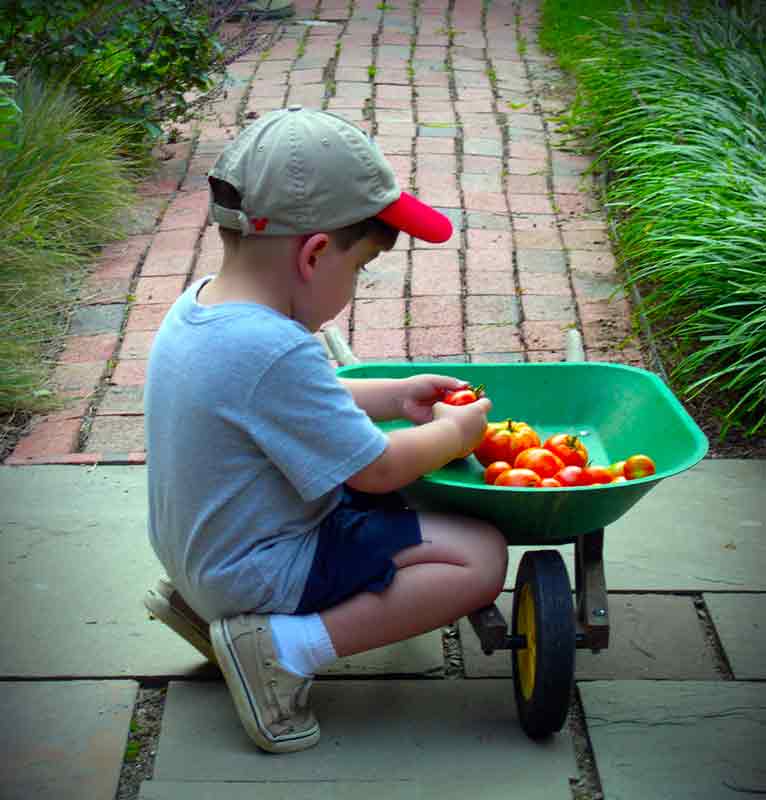 Lucas at 5 years old with his morning harvest Lucas at 5 years old with his morning harvest I hope this gives you a better insight on the long, special voyage the Tomato has made... from the Andes mountains, across the sea to Spain, Italy and the rest of Europe, then back to the United States with the influx of Italian Immigrants. The tomato is alive and well all over the world, but especially in Italy. They've adopted this little nightshade fruit and made it their own... --Jerry Finzi Resources: Annies Heirloom Seeds Heirloomseeds.com Seedsavers Exchange Growing Heirloom Tomatoes in Pots Old House Journal Article: How to Grow Heirloom Tomatoes Please, stop by our SURVEY and spend 60 seconds telling us how we could make our blog better! Grazie! You can also follow Grand Voyage Italy on: Google+ StumbleUpon Tumblr Copyright, Jerry Finzi, Grand Voyage Italy, All rights reserved 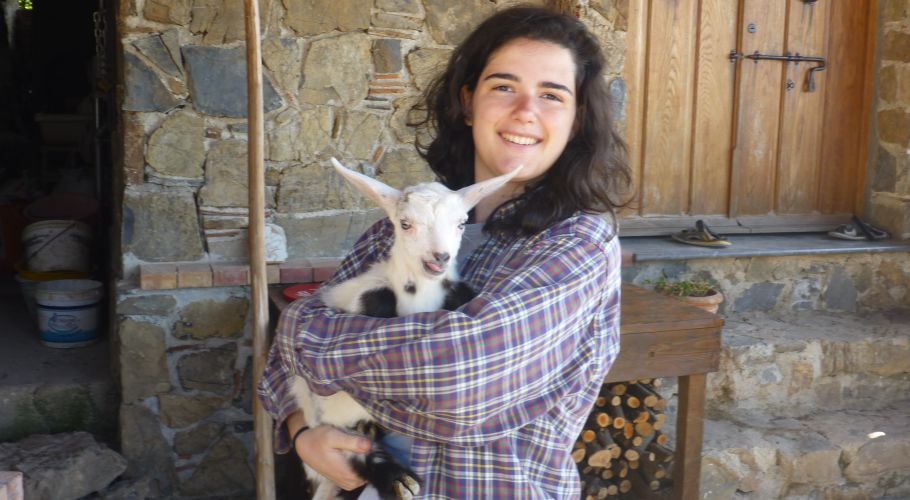 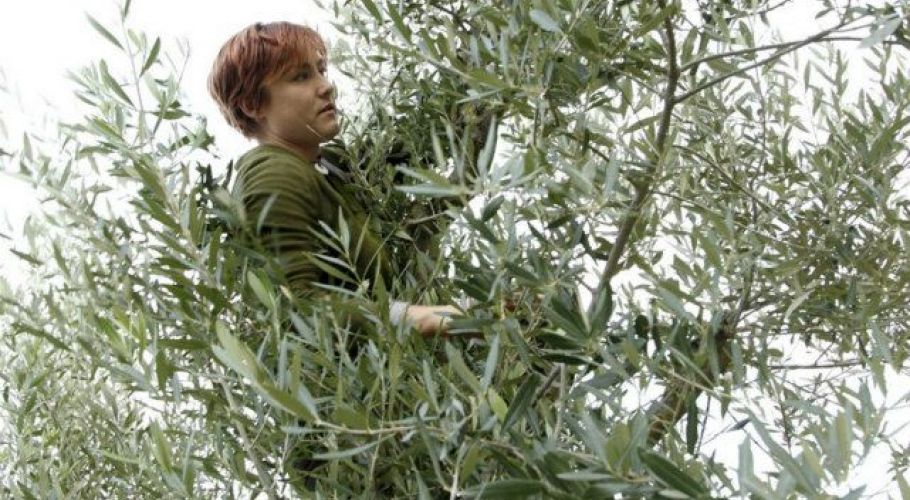 Olive harvesting Olive harvesting Many people have dreams of spending their Italian vacation on a farm... seeing cheese and wine made, perhaps learning how to make pasta, milk a goat or make fresh sausage. Of course, you can always spend your vacation on an agriturismo in the region of your choice. An agriturismo will typically have fairly posh and comfy apartments or rooms, wine tastings (for extra $$$), cooking lessons (again, more $$$) and even their own restaurants on site--some include meals, most don't. You can find some that are historic and agriculturally oriented, but many are simply overly developed investment hotelier or B&B properties often owned by non-Italian investors and staffed by young, inexperienced hotel staff. The wine and olive oil they produce and sell to tourists are not known to be high quality. If you research meticulously, you can find some that are actually working farms run by the same family that lives and works on the farm. But there is another way to have an authentic, hands-on experience with Italian agricultural organic techniques, food-to-table, and Slow Food movements.... WWOOF is a worldwide movement linking volunteers with organic farmers and growers to promote cultural and educational experiences based on trust and non-monetary exchange--yes, people work for free--but they gain a whole lot more than money in these experiences. The goal of the organization is to help spread the message of building a sustainable global community. As the average age of farmers is 55, the world needs more young people to return from the big city job centers to sustain farming--especially organic methods--and carry on the skills and craftsmanship needed for smaller, owner-operator farms to survive. Many young Americans see this as an opportunity to learn authentic skills that they can use to start their own green enterprises at home. 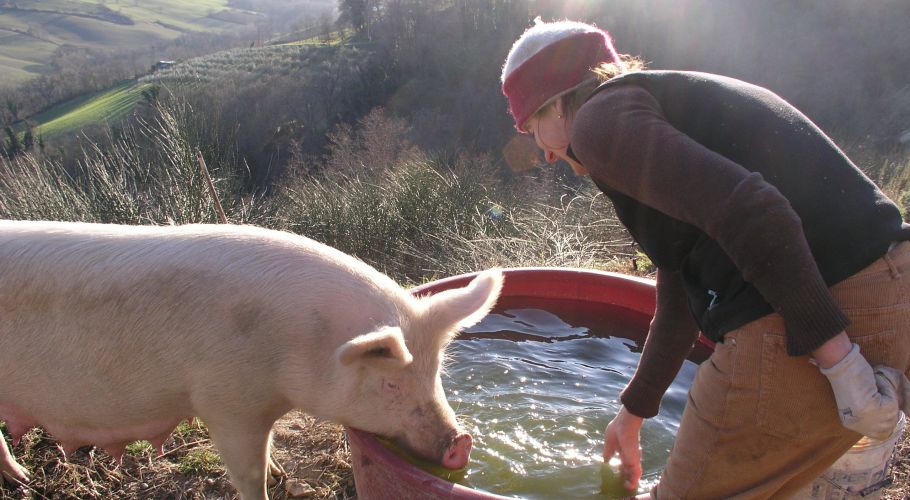 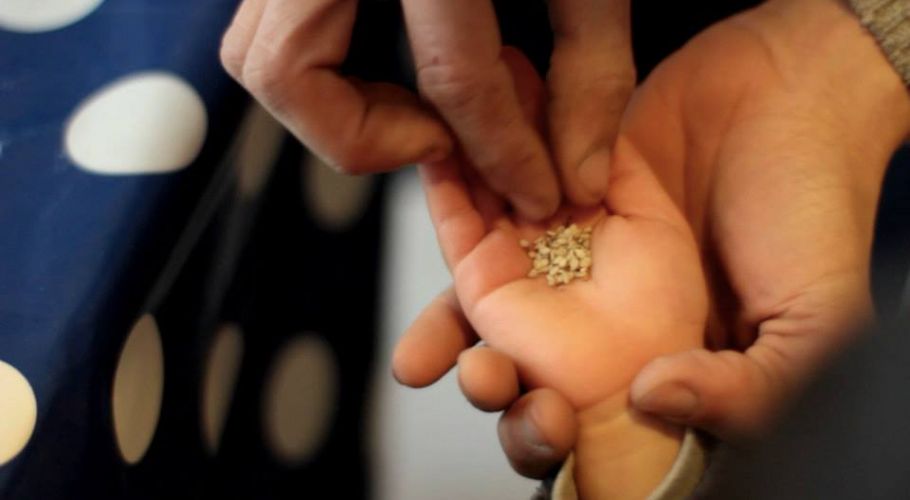 Planting the seed of knowledge Planting the seed of knowledge What is WWOOFing? WWOOF stands for World Wide Opportunities on Organic Farms, but the concept of having a working vacation on farms has been around for a while under the older Willing Workers on Organic Farms, where city dwellers in the UK volunteered on organic farms in the countryside. Always wanted to work on a farm? Want to learn some skills to help start your own organic farm? Want to learn the Slow Food method of growing and then producing your own artisanal food products? Read on... you might have just found a great way to have a very valuable experience...
 Crushing grapes the old-fashioned way Crushing grapes the old-fashioned way There are WWOOF farms in many countries around the world... and luckily for the Italophile interested in honing their organic skills, Italy has many opportunities, too. Membership for one year is €35. There are over 650 WWOOF host farm members in Italy in many areas of specialty: cheesemaking, olives and olive oil production, vines and wines, sheep & herding, goats, almonds, fowl (chickens, ducks and others), cows & milking, pigs & sausage, butchering, beekeeping, hay & cereals and vegetables of all kinds. In addition, some offer opportunities to learn construction trades relating to farming... carpentry, masonry, historic restoration, blacksmithing and more. 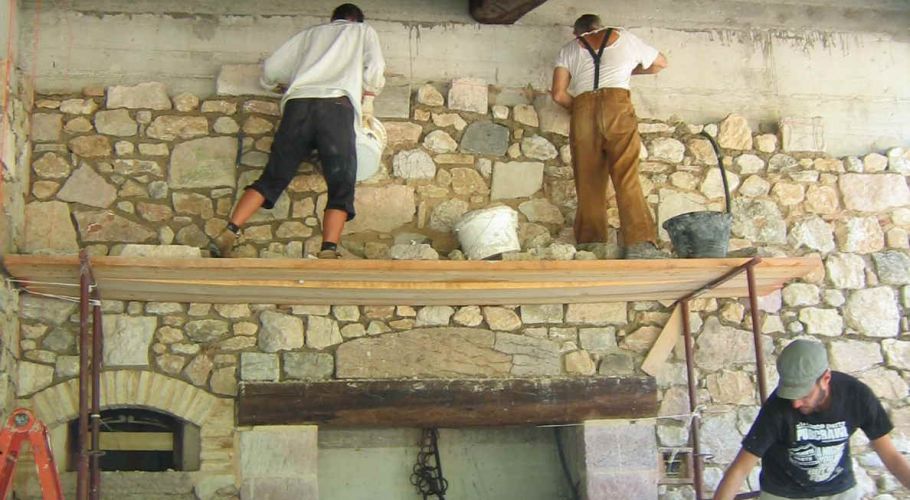 Restoring a masseria farmhouse 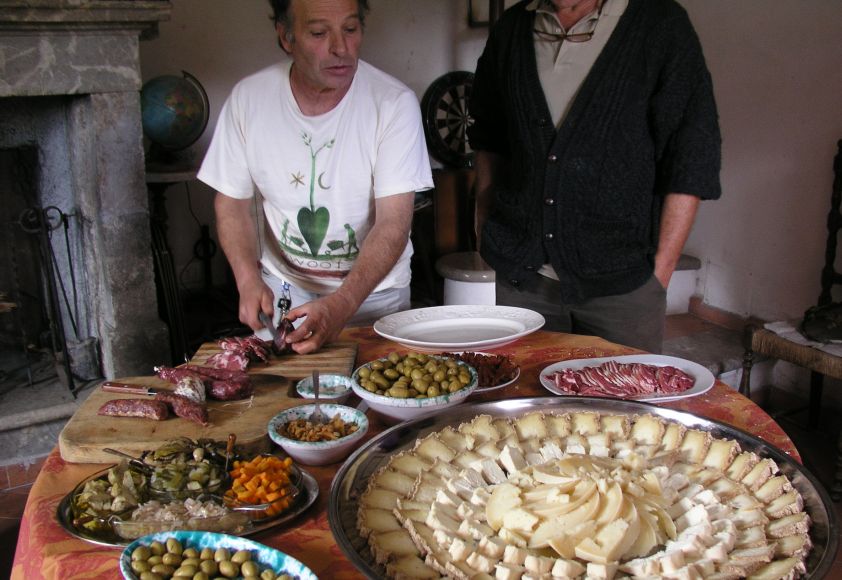 The meals can be fantastico! The meals can be fantastico! Volunteers stay in a variety of accommodations from tents to castles, Trulli to masseria farm complexes, converted barns and shared dorms. There are even those that welcome entire families with programs for children. The WWOOF site has an excellent keyword driven search engine that can help you locate a perfect match for the skills you are interested in experiencing first hand. Click for a LIST OF WWOOF Farms in Italy. To register for a WWOOF experience, SIGN UP HERE. 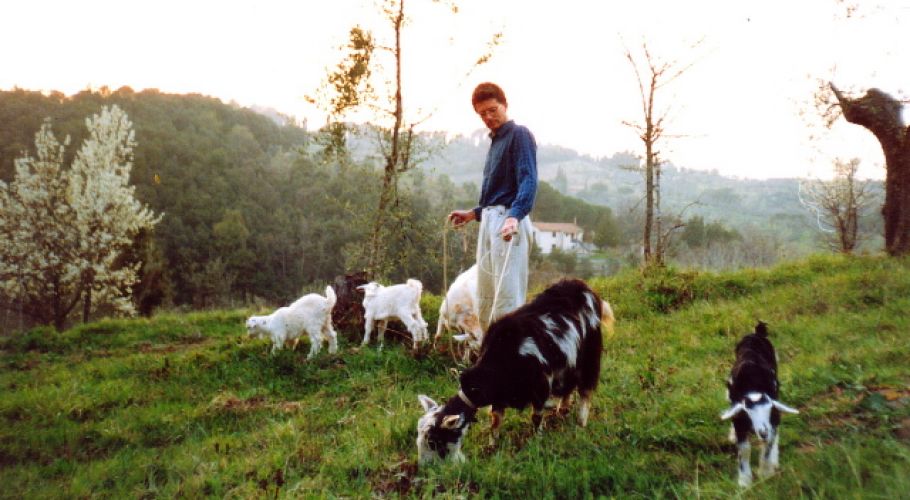 Goatherding 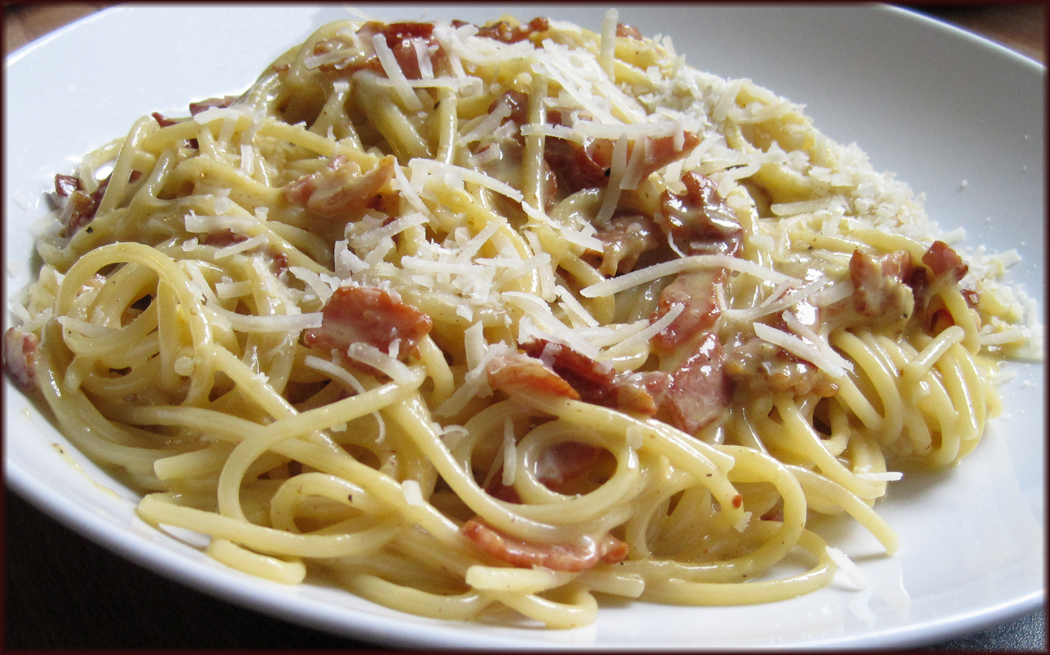 Pasta alla Carbonara is something we never ate before Italy. When we had it, we loved it. It seemed difficult to get a bad plate of it. When we returned, I researched a few recipes online and made adjustments based on my memories of how it tasted on our voyage. First, some history. The name comes from a dish made in the Appenine mountains by charcoal makers. They cooked the dish over a hardwood charcoal fire and used penne rather than spaghetti because it is easier to toss with the eggs and cheese. "Alla carbonara", literally means "in the style of a coal worker". Some even say that the addition of coarsely ground black pepper resembles coal flakes. It's a fairly simple to make a basic carbonara... some sort of pasta that holds sauce well, but has lots of surface area that will temper the eggs quickly without actually cooking them. Spaghetti, bucatini (a hollow spaghetti) and linguini work well, but to remain authentic you might use penne rigati--the ridges would hold the sauce well. Next, you need something smoky and salty... bacon and cheese. Romano is great. Any kind of bacon or ham works... Pancetta, Canadian bacon, prosciutto, even Black Forest ham. I tend to use cut up pieces of Boar Head brand's Piccolo Prosciutto, sauteed a bit in a pan before time. You can add some diced onion at the beginning too. Then there's the level of spice. Ground black pepper is classic. Slice up some garlic and heat that up at the end and you'll be in heaven. Some pepper flakes added when sautéing the bacon will add heat. Be careful of salt though. The grated cheese and bacon will have enough salt. The main trick is NOT adding the egg mixture (beaten eggs and cheese) to the hot pan. Instead, after draining the pasta--immediately after when it's still steaming--toss the pasta with the egg mixture in a bowl until creamy. This is enough to lightly temper the eggs without actually cooking them. Another addition could be reducing some cream, half-and half, or even skim milk added toward the end and reduced and thickened, but this is not a classic technique. A traditional carbonara is made creamy with just the eggs and cheese. Another variation on this would be to use some chicken broth instead of the cream. I suggest trying a basic recipe for carbonara before getting fancy. It's a pretty simple dish, but the timing is key. And if you insist on making it the way many TV chefs do--in the hot pan--at least remove the pan from the heat for a minute or so before adding the egg... Enjoy the video of Chef Antonio Carluccio from BBC's Two Greedy Italians making his authentic version! Buon appetito! --Jerry Finzi Please, stop by our SURVEY and spend 60 seconds telling us how we could make our blog better! Grazie! 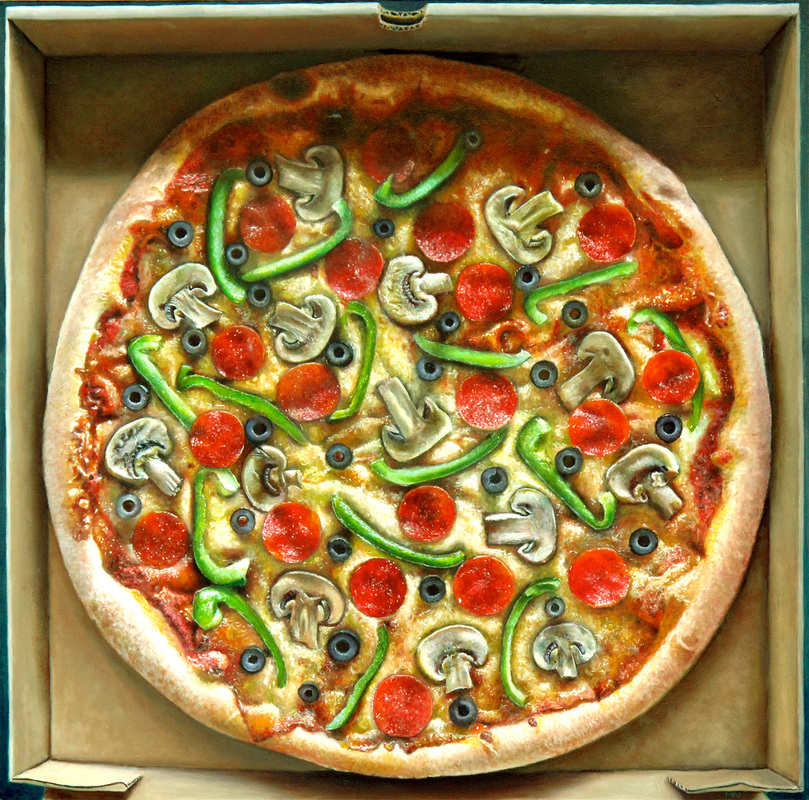 Delivery Pizza, Mary Ellen Johnson 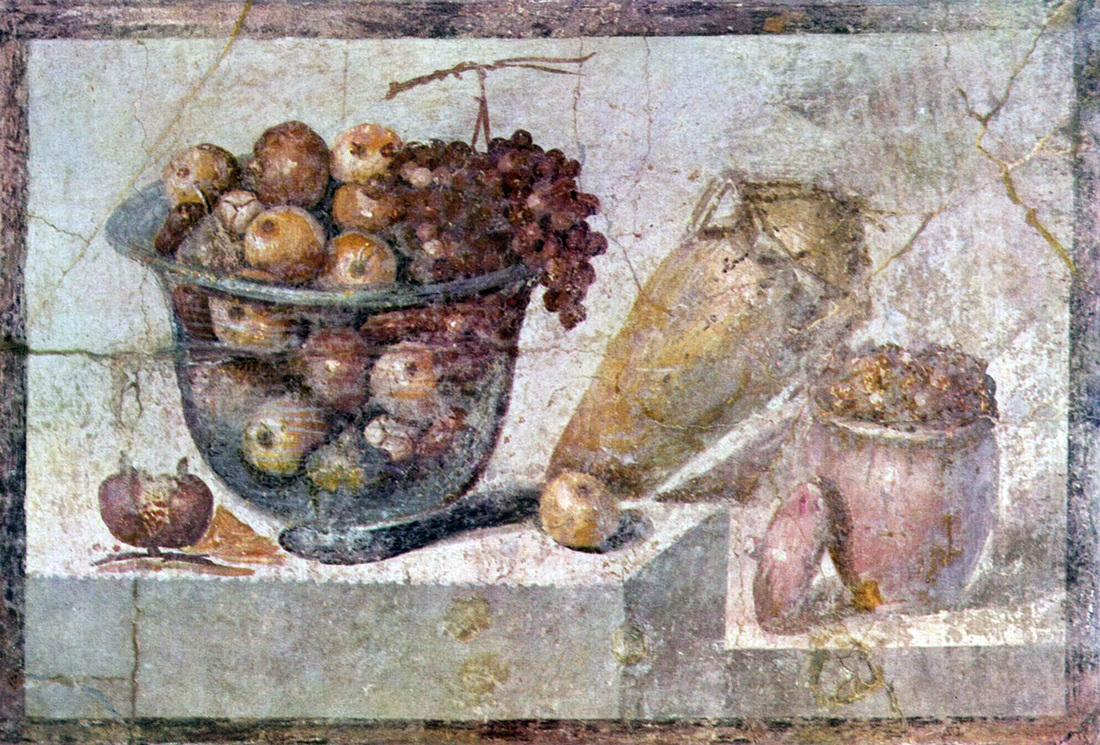 Roman Tromp L'Oeil fresco Roman Tromp L'Oeil fresco The art of Trompe L'oeil (fool the eye) has been around for at least two thousand years... as evidenced by frescoes and mosaics from Pompeii and Herculaneum. Artists have always attempted to make their works seem as realistic as possible--of course, it all depends on the skills of the artists' hands and eyes, some being better than others. When they added realistic shadows, cast from the same direction as the real world light in the viewing room, the effect was magical. When they would put a life sized mouse running along the edge of the floor, the reality effect was enhanced. If they made some elements like grapes or vines seeming come right out of the frame and onto the wall, you felt like you could reach out and touch and feel what your eyes perceived. While Tromp L'Oeil usually keeps the objects the same size as the item is in real life to trick the eye into thinking the two dimensional objects are really three dimensional things coming out of the painting and into our real world, modern day Photo Realism or Hyper Realism painters of today have a different goal: to fool the viewer into thinking that they are not looking at paintings at all, but photographs or digital captures of real life. 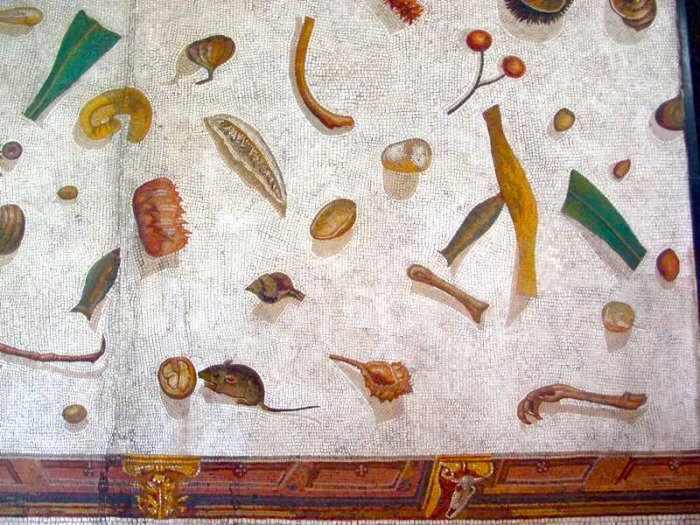 A "unswept floor" Trompe L'oeil mosaic from Pompeii A "unswept floor" Trompe L'oeil mosaic from Pompeii I find it curious that photography has become the symbol of "reality" rather than real life. When photography was in its infancy, artists were in an uproar (especially portrait artists) because they were losing assignments to people who they claimed were not artists, but merely technicians clicking the shutter on a machine. In no way could photography become a true art form. It's amazing to see how photography has become both a form of artistic expression and a way to capture reality as if the viewer was looking through a window at the real life scene. It's also curious how it has come full circle and painters are now imitating photography. In any event, I've collected a small sampling of Hyper Realism paintings of food relating to Italian cuisine... Enjoy... --Jerry Finzi 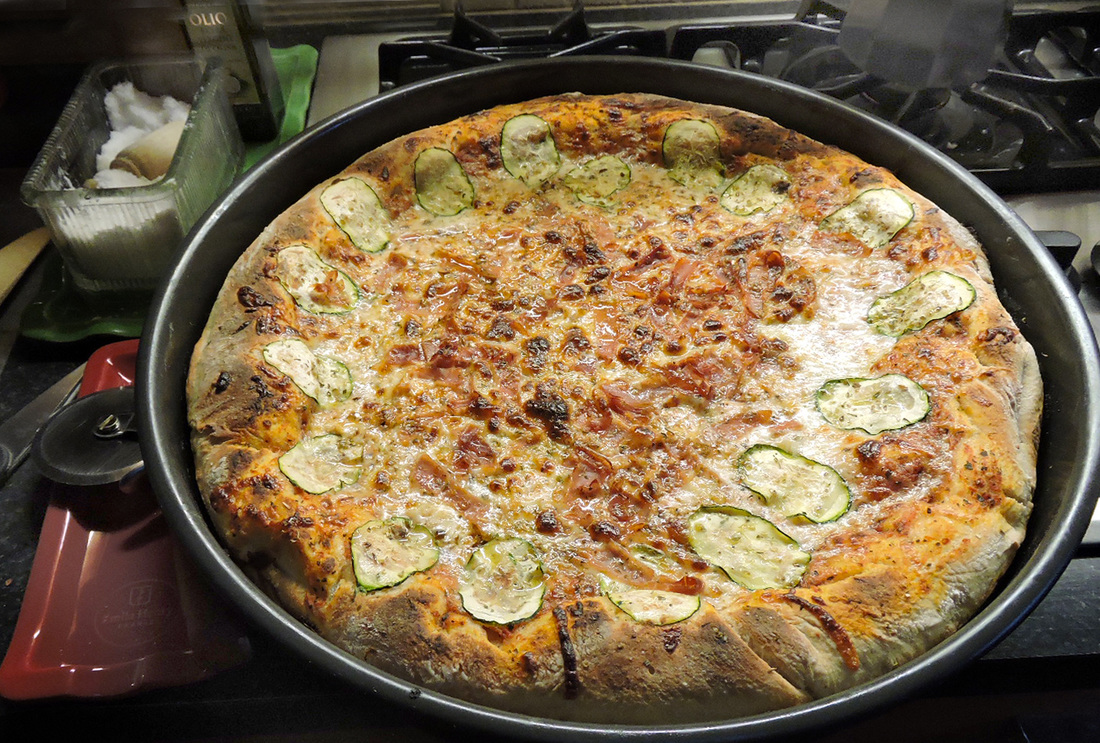  Here's a variation of a pan pizza that I made last night for our Saturday Night Pizza. The crust is pretty much the same as in my article Nostra Cucina: Deep Dish Chicago Style Pizza Recipe - the Upside-Down Pizza except that I used a ratio of 1/3 Bread Flour, 1/3 All-Purpose Flour and 1/3 White Whole Wheat Flour (all King Arthur brand).
The addition of All-Purpose flour in this recipe makes the crust a bit... well, crustier... while still having a nice bready interior. The sauce is a very simple recipe: 1 - 28 ounce can of Tuttorosso Crushed Tomatoes with Basil (my new favorite) 2 tsp sugar 2 tsp dried basil 2 pinches sea salt 2 tablespoons extra virgin olive oil 3 cloves diced garlic cloves 1/4 tsp hot pepper flakes (pepperoncino) Heat all the ingredients for 10 minutes, then set aside as you make your pizza. This makes enough sauce for 4-6 pizzas and could also be used on pasta. The toppings were simple enough. Sauce first, then spread grated, smoked mozzarella (I like the drier, packaged type for use on pizza... like Boar's Head brand), then place paper thin slices of zucchini all around the perimeter (I used my mandoline). Cut up some thinly sliced Piccolo Prosciutto (Boars Head brand) or Speck into 1" x 2" strips and spread on top of the pizza. Drizzle with EVO. The pizza baked in my oiled, 16" deep dish, dark pan for 15 minutes at 425 degrees F. The oven had been preheated with my pizza steel on the middle rack. At the end of baking, when the crust looked nicely browned underneath (I checked with a spatula), I turned the oven to broil for another 2 minutes. Cool for several minutes before slicing. Buon appetito! --Jerry Finzi You can also follow Grand Voyage Italy on: Google+ StumbleUpon Tumblr Then all of a sudden, Lisa was in the kitchen whipping up these perfect Devils Food Cupcakes... 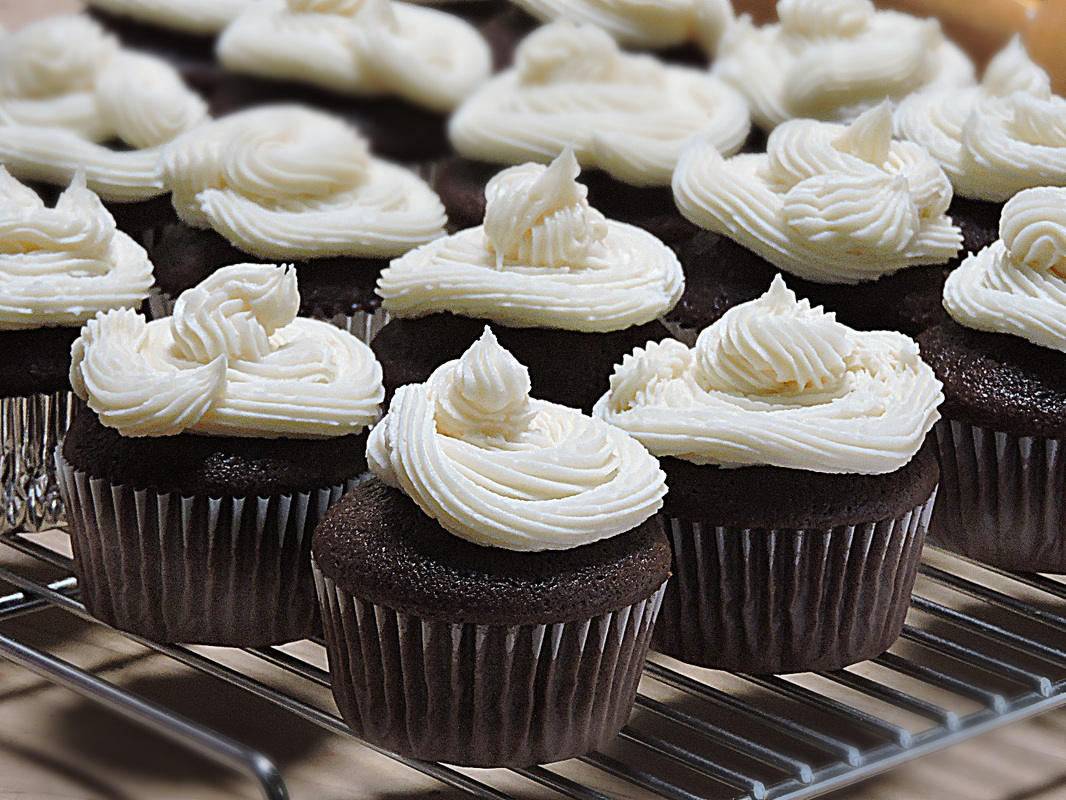 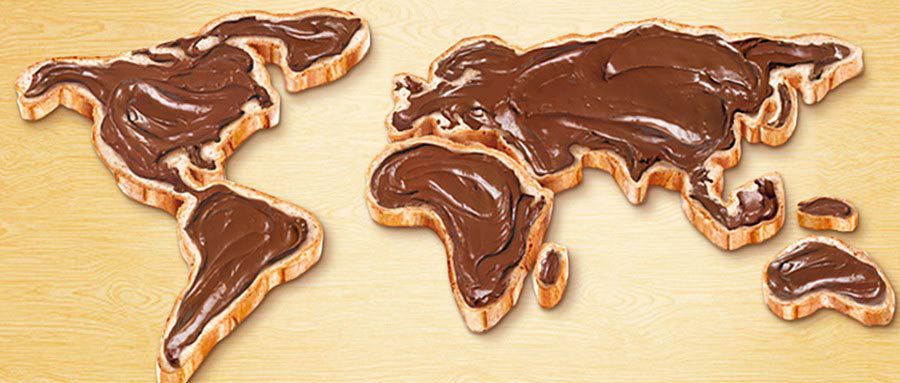 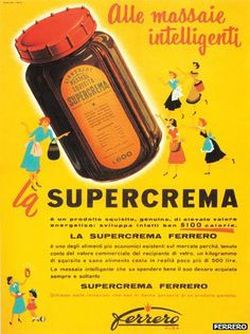 Supercrema ad Supercrema ad Lucas has developed a particular Italian habit since voyaging through Italy: Every few days he craves a Nutella breakfast... a couple of Mom's waffles from the freezer, toasted and spread with that oh-solo-mio good chocolate-hazelnut buttery Nutella. He's not alone. Nutella may have been born in Italy, but it's a product beloved by people all around the world. It was Pietro Ferrero, a baker in Alba, Piedmont, the hazelnut capitol of Italy, who first created the solid Pasta Gianduja in 1946. This was the precursor of a much more creamy version he called Supercrema in 1951. By 1963, Ferrero's son Michele tinkered with the Supercrema recipe and developed what we now know as modern Nutella. It's popularity spread (pardon the pun) swiftly within a year throughout Europe. Today many people around the world are over the top nutty over Nutella. For instance, recently in a family court in Valenciennes, France, a sensible judge ruled that a couple could not call their 4-month-old daughter "Nutella" because it was contrary to the girl's interest and "can only lead to teasing or disparaging thoughts." Since the otherwise excellent parents failed to show, the judge legally renamed her "Ella." (In France registrars must pass names of newborns before a judge to rule if the name is against the child's interests. I suppose it was best that I didn't name Lucas "Pizza"!) Now many people think of Nutella as a totally healthy snack food. Think again. The main ingredients of Nutella are sugar, palm oil, hazelnut, cocoa, and skimmed milk (the latter being the only truly healthy ingredient). Ferrero uses so much hazelnuts that fully 25% of the world's supply is used to produce Nutella. Two tablespoons of the stuff contains 200 calories--99 of which come directly from saturated fat (palm oil is a real no-no for heart health). Here's a breakdown: 10.5 % saturated fat and 58% processed sugar. Each two tablespoons contains 11 grams of fat (3.5g saturated), 21 grams of sugar, 15 mg of sodium, and a mere 2g of protein (from the hazelnuts, which are also high in fat). Now don't get me wrong, we use Nutella in our home. We like it, although I stay away from it (chocolate isn't good for me). But it has to be used in moderation. That's why I don't let Lucas eat it more than twice a week for breakfast... and even then, on only 1/2 of one of Lisa's leftover waffles that we keep in the freezer. In fact, Ferrero was party to a class action suit for false advertising in the U.S. for claims that Nutella had health benefits and was "part of a nutritious breakfast". In 2012 Ferrero paid a $3 million settlement (up to $4 per jar for up to five jars in returns by customers). 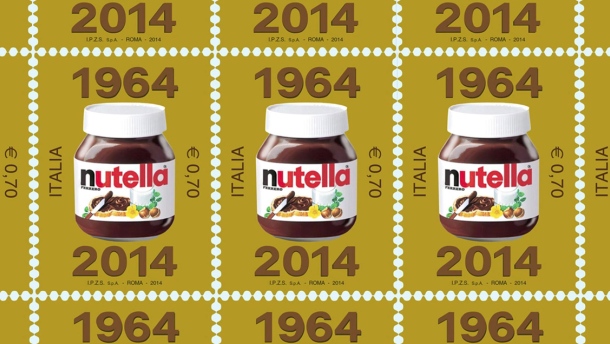 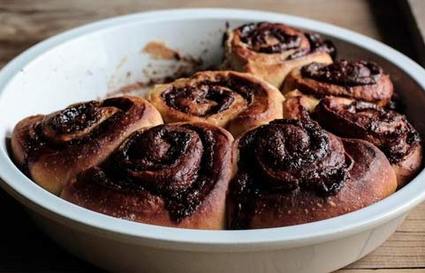 Because of this, Nutella is one of what we call "Once in a Blue Moon" foods in our pantry. I came up with the concept when Lucas was a toddler. We don't do fast food restaurants and try to make our meals from scratch at home. So, if you want to try using Nutella "Once in a Blue Moon", here are some recipes I collected for you to try: Nutella Espresso Rolls (from A Pastry Affair) Yields 9 rolls Espresso Dough 1/2 cup (118 ml) milk, barely warmed 2 tablespoons butter, melted 1 1/2 teaspoons active dry yeast 2 teaspoons espresso powder 3 tablespoons granulated sugar 1 large egg 2 cups (250 grams) all-purpose flour In a large mixing bowl (or bowl of a stand mixer), sprinkle the yeast over the barely warm milk and melted butter and allow to sit about 5-10 minutes until activated (looks frothy). Mix in the espresso powder, sugar, and egg. Gradually add in the flour, mixing until the dough comes together. If the dough is too dry and will not come together, add small amounts of water until it does. Conversely, if the dough is too sticky, add flour until it becomes workable; however, do not add too much flour or the bread will become dense. Turn out the dough on a lightly floured surface and knead the dough for 7-10 minutes, or until elastic. Alternatively, using the dough hook on a stand mixer, knead the dough for 7-10 minutes, or until elastic. Cover dough with plastic wrap or a kitchen towel and let rise until doubled in a warm place, about 2 hours. Nutella Filling 1/4 cup (50 grams) brown sugar, packed 1 teaspoon espresso powder 1/2 cup (150 grams) nutella In a small bowl, mix together the brown sugar and espresso powder. On a lightly floured surface, roll out the dough to 11 by 15 inch rectangle. Spread the dough evenly with the nutella, leaving a 1/2-inch border around the edges Sprinkle on the brown sugar mixture. From the longer end, roll the dough very tightly until it forms a log. Cut off the ends of the dough and cut the log into 1 1/2-inch segments. Place the rolls into a 10-inch round pan. Cover and allow the dough to rise until it doubles in size, about 45 minutes to 1 hour. Alternatively, you can also make the rolls the night before and allow them to double in size in the refrigerator overnight. Preheat the oven to 375 degrees F (190 F). Bake for 15-20 minutes, or until the tops are golden. Serve hot.
 Nutella Cheesecake Squares (from Coconut & Lime) Ingredients crust: 1/2 cup old-fashioned rolled oats 1/4 cup flour 1/4 cup cocoa 1/4 cup dark brown sugar 1/4 cup butter, melted 1/8 teaspoon salt filling: 16 oz cream cheese, at room temperature 1/4 cup Nutella 1/2 cup sugar 2 tablespoons flour 2 large eggs,at room temperature Directions Preheat oven to 350. Grease or spray with baking spray an 8x8 inch pan. In a small bowl, add the butter, sugar, flour, cocoa, oats and salt, mix thoroughly with a fork. Press into bottom of the pan. Use the bottom of a measuring cup to flatten and press firmly. Bake for 15 minutes. Meanwhile, cream together the cream cheese and sugar. Add the egg and flour, beat until smooth. Pour about 2/3 of the batter into the 8x8 inch pan. Add the Nutella into the remaining batter and mix thoroughly. Spread on top of the first cheesecake layer. Bake 25 minutes or until set. Cool in pan on wire rack. Cut into squares. 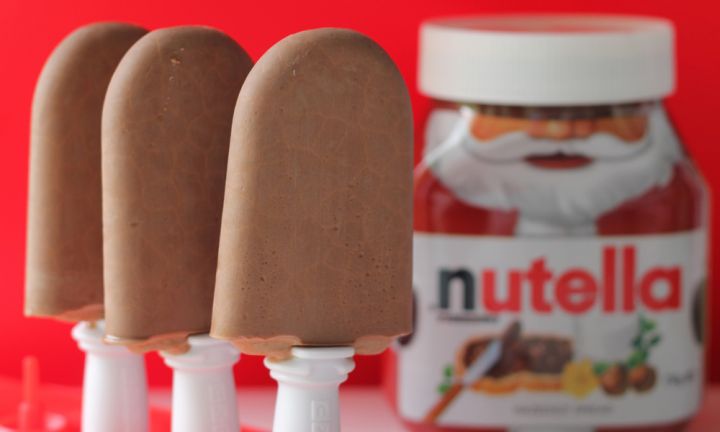 Nutella Fudge Pops
(Makes 6-7)
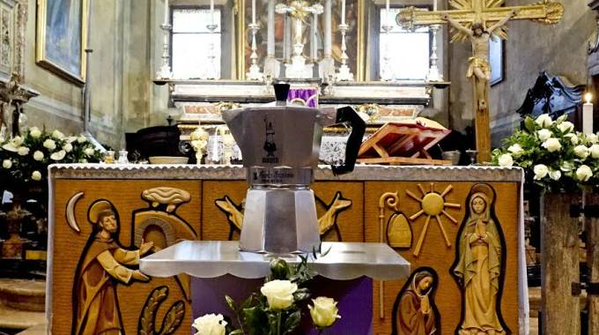  Some say Italians are strange. Perhaps so, but some of their strangeness might be due the the passionate and often unusual way they live their lives... and end them. Moka espresso pot pioneer and marketer, Renato Bialetti, died in February and was laid to rest. (Read the GVI article HERE) But he was not laid to rest in the way most Catholics are in Italy... With the deceased body being viewed and kissed by all, a procession to the cemetery on the outskirts of town, and the coffin placed into a concrete mausoleum with a photo of the person on the front plaque. You see, Alfonzo Bialetti, Renato's father, was the inventor of the Moka pot, but it was Renato who was the genius responsible for marketing the Moka as the world knows it today. It was his huge mustache that inspired the little character that is emblazoned on every Moka pot sold in the world. He is the one responsible for marketing the Moka to people outside of Italy and Europe.  So it should be considered appropriate that as his last, big marketing campaign, Bialetti was was cremated and his ashes were placed in a huge Bialetti Moka pot. The priest from St. Thomas the Apostle in Montebuglio, Lombardy held a funeral mass, swung the incense around the Moka and put Renato to rest. In Italy, there is a lack of space for new burials, but this wasn't the reason for the cremation and placing Bialetti's ashes into a Moka. He will be interred in the family's cemetery plot in Omegna, Lombardy. Renato something knew about great public relations.
We all hope he will rest in eternal peace, that is, if all that espresso doesn't keep him up. Every time we pick up a Moka pot we'll imagine him inside... Jerry Finzi You can also follow Grand Voyage Italy on: Google+ StumbleUpon Tumblr 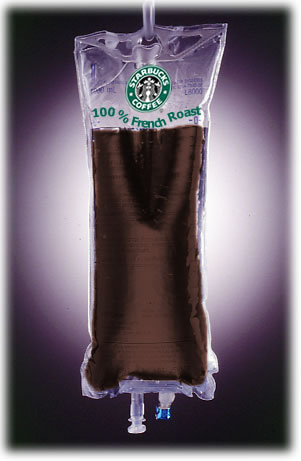  Personally, I'm not a coffee drinker. I've never understood the love of that bitter, acrid flavor or the desire of most coffee drinkers to want a scalding hot drink that they sip gingerly for fear of burning their tongues. I tried drinking coffee when I was a teen, and although I loved the smell of coffee beans, I couldn't get into the taste of coffee. The closest I came was when my Greek brother-in-law at the time got me into having his morning "breakfast coffee" (as he called it) with lots of sugar, milk and a whole egg dropped into it. More than likely this is what put a few hairs on my thirteen year old chest as I helped Yiorgos paint houses that summer. I soon realized that I was not the coffee type... But of course, the world is full of coffee lovers--no... addicts. This is how I tend to see coffee--as a drug that can addict the drinker. I had one assistant in my studio who was really addicted to coffee. I had a coffee machine mainly to serve clients when they came to photographic shoots, but it got daily use from my assistant to serve his addiction. This was when we were doing lots of jewelry photography which involved surgeon-like precision manipulations of wrist watches, chains, pearls and diamonds. The work took a stead hand, but my assistant's hands shook like an addict in Alphabet City from indulging in over 10 cups of coffee each day. I worry about this when my wife Lisa drinks a bit too much coffee or espresso from her Moka pot (she tends to exclusively use the largest Moka in her collection). She also tends to be prone to caffeine energy spikes... I can tell when she's "high" on the stuff. I worry about any effects caffeine might have on her kidneys, her blood pressure, and her acid reflux (ok... perhaps I worry too much, but she is "my gal" and Lucas' Mom, after all). We always get into debates on the health aspects--or lack thereof--of coffee and espresso. I'm not a tyrant on the subject... in fact, I'm the one that tends to buy her Moka pots and stuff her Christmas stocking with exotic flavored coffee beans. Lisa throws every new report about coffee at me... "See? Coffee protects against diabetes, Parkinson's disease, liver disease, liver cancer, and is good for your heart!" Just about every month or so there are more and more contradicting studies about what is and isn't good for our health. But on the heels of some recent reports suggesting that drinking coffee is good for our health, a new study suggests that even a single cup of espresso can lessen the flow of blood to the heart by 22 percent within one hour of being consumed. (You see, Lisa? Put that in your Moka but don't drink it!) Published in the European Journal of Clinical Nutrition, the study confirms that high levels of caffeine found in a single espresso have negative cardiovascular effects. This is especially troubling in Italy, where an espresso or two in the morning jump starts workers' days--a great concern, even considering that Italy recently was deemed the healthiest country in Europe. (Read ITALY: Healthiest Country in Europe HERE) Even in the U.S. and the UK, espresso consumption is on the rise, along with all the multitude of flavored and high calorie, large serving sized coffees on the market. Many coffee shops are pushing the "hard stuff" on the coffee addicted public, along with introducing caffeine to a younger and younger audience. In one case, a 17 year old girl was rushed to hospital after overdosing on espresso with an elevated heartbeat, fever and hyperventilation after seven double espressos. Holy Doppio! Along with a shot of espresso reducing blood flow to the heart, blood pressure itself also rises significantly. As expected, decaffeinated coffee had no harmful effect on blood flow or blood pressure. The study was carried out by a team at the University of Palermo in Italy, examined the effects of a single espresso shot on 20 adult volunteers, compared to a decaffeinated alternative. They measured how much blood vessels dilate when blood flow is increased. Healthy blood vessels will stretch open to let more blood pass through easily. Within just an hour of consuming a single espresso, blood flow had reduced by an average of 22%, which depending on the overall health of the individual, in worse case scenarios, could lead to heart attack or stroke. 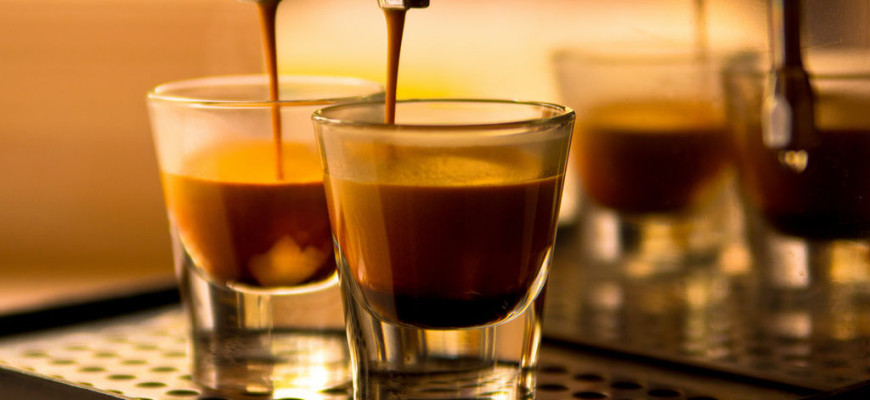 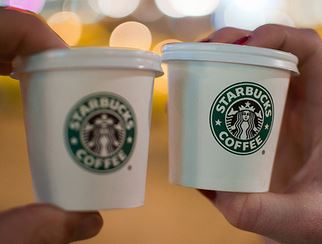 Health experts advise not to drink more than four cups of coffee a day (namely, an 8 ounce cup). A typical 8-ounce cup of coffee contains up to 15 mg of caffeine per ounce of brewed coffee... that's 120mg per 8 ounce cup (in a Trenta that's 450mg of caffeine!) In espresso, the servings are typically smaller, but the concentration of caffeine is more concentrated at up to 50 mg/oz. This means that an Italian sized one ounce shot of espresso contains 50 mg of caffeine and a Doppio (double shot) contains 100 mg of caffeine. By this math, a Starbucks "Quad" should contain 200 mg of caffeine, but even on Starbucks own website, they list a Quad as having 300 mg of the drug! Of course, it's in Starbucks' own best interests to up the caffeine content to get even more customers hooked on the black stuff. As for me, I'll stick to herb tea... and keep telling Lisa that having her espresso is what we call in our family a "Once in a Blue Moon" treat. For Lisa, that's once a week with Sunday breakfast... --Jerry Finzi You can also follow Grand Voyage Italy on: Google+ StumbleUpon Tumblr Copyright 2016, Jerry Finzi/Grand Voyage Italy - All Rights Reserved
|
Categories
All
Archive
January 2021
|




 RSS Feed